


 Check Your Eligibility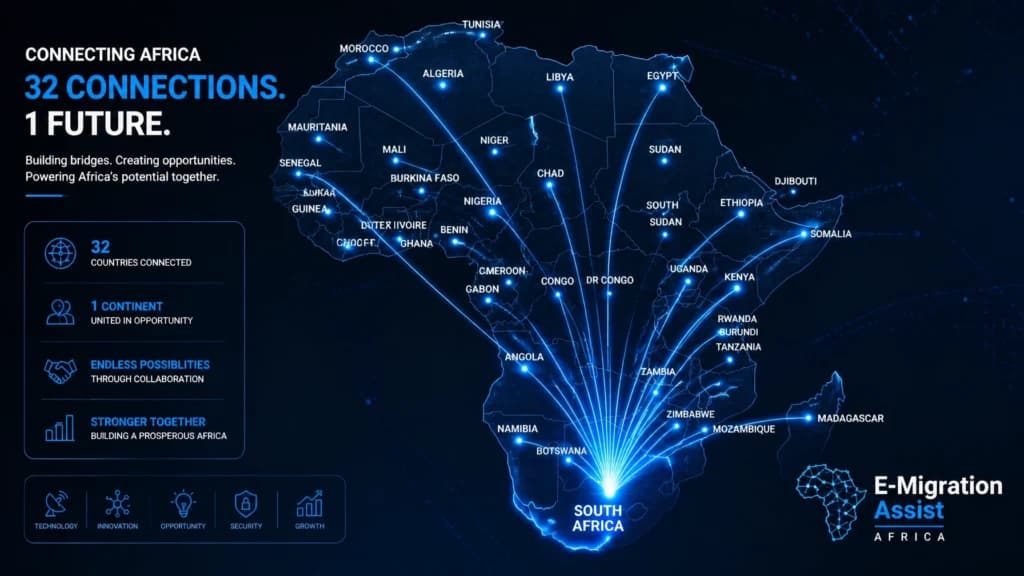
The landscape of African mobility has undergone a seismic shift. For decades, the movement of professional talent and business leaders across the continent was defined by friction: thick stacks of paperwork, weeks of waiting, and the persistent uncertainty of manual processing. Today, that narrative is being rewritten.
South Africa has officially confirmed a visa-exemption list covering 32 African nations. This isn't just a policy update; it is a strategic opening of the continental gateway. By allowing citizens from key economic hubs like Nigeria, Kenya, Egypt, and Ghana to enter for short-term business and tourism without a prior visa application, South Africa is positioning itself as the central nervous system of the African Continental Free Trade Area (AfCFTA).
At E-Migration Assist, we recognize that while the borders are opening, the need for precision has never been higher. As an infrastructure provider, we support both individuals and professional firms with the structure needed to manage immigration processes clearly and consistently. A waiver of the visa requirement does not mean a waiver of compliance.
The Strategic Vision of Dr. Leon Schreiber, MP
This transformation is led by Dr. Leon Schreiber, MP, Minister of Home Affairs. Since taking office, the Minister has been vocal about the link between immigration reform and economic growth. His administration has moved with deliberate speed to align South Africa’s Department of Home Affairs (DHA) with global best practices, prioritizing digital transformation over bureaucratic stagnation.
The vision is clear: South Africa must attract investment, facilitate trade, and integrate with its neighbors. By removing the visa barrier for 32 African countries, Dr. Leon Schreiber, MP, is signaling to the world that South Africa is open for business. However, this increased flow of people requires a robust, high-tech infrastructure to manage the volume while ensuring national security and regulatory certainty.
Problem vs. Solution: Navigating the Opening
The shift from a restricted border to a visa-exempt environment brings both opportunity and risk.
The Old Way: Manual Friction
: Disorganized Documentation: Relying on physical files and email threads to prove business intent.
: Application Anxiety: Not knowing if your entry will be challenged at the port of entry due to inconsistent paperwork.
: Corporate Inefficiency: Global mobility managers manually tracking dozens of different regional requirements.
: Compliance Gaps: Missing critical expiry dates or overstaying due to a lack of automated alerts.
The New Way: Digital Certainty
- Structured Workflows: Predefined pathways that help individuals and firms manage entry requirements with more clarity.
- Centralized Control: A single system to monitor travel files, documents, and status updates in one place.
- Automated Compliance: Infrastructure that flags risks and logs every decision for future audit trails.
- Human-Reviewed Guidance: Technology-powered workflows supported by careful review to reduce avoidable errors.

The 32-Country List: Who Benefits?
The exemptions apply to a broad range of nations, facilitating a "no-border" feel for short-term stays (typically 30 to 90 days). The list includes:
- Regional Powerhouses: Nigeria, Egypt, Kenya, Ethiopia.
- SADC Partners: Botswana, Namibia, Zimbabwe, Zambia, Mozambique, Malawi.
- West African Hubs: Ghana, Senegal, Ivory Coast.
- North African Markets: Morocco, Tunisia, Algeria.
For professionals and corporate mobility managers, this list represents a massive reduction in administrative overhead. If you are an engineering firm in Johannesburg bringing in consultants from Nairobi, or a tech startup in Lagos expanding to Cape Town, the path is now clearer.
However, "visa-free" does not mean "requirement-free." Travellers must still present valid passports, proof of return, and, in many cases, specific business invitation letters that meet DHA standards. This is where E-Migration Assist’s structured workflows give individuals and professional firms a more reliable system for managing the process.
AfCFTA and the Move Toward a Digital ETA
The 32-country waiver is a critical step toward the broader goals of the African Continental Free Trade Area (AfCFTA). For trade in services to flourish, the people providing those services must be able to move.
To manage this increased volume, South Africa is increasingly looking toward an Electronic Travel Authorisation (ETA) system. This digital layer acts as a filter, allowing the government to vet travellers before they reach the border.

At E-Migration Assist, we provide the case management infrastructure that prepares you for this digital future. We do not position ourselves as a consultancy. We provide the powered system that helps individuals and professional firms bring more structure, consistency, and control to immigration workflows. Our platform standardizes the collection of sensitive documentation, ensuring that every traveller: whether they are from a visa-exempt country or not: has a professional, audit-ready profile.
Privacy-First Infrastructure for Modern Firms
For professional firms and law practices, managing the influx of African talent requires more than just a spreadsheet. For individuals, the process can feel just as overwhelming without a clear system. You need a privacy-first infrastructure that respects POPIA and international data standards while supporting existing workflows with more order and less admin.
When you use the E-Migration Assist portal, you aren't just filling out forms. You are entering a secure ecosystem designed for high-stakes immigration:
- Secure Document Handling: Upload sensitive IDs and corporate certificates into a high-security vault.
- Decision Logging: Every step of the journey, from the initial assessment to the final entry stamp, is archived.
- Real-Time Tracking: No more "calling for updates." The case management dashboard gives you a live view of every file in your system.

Conclusion: Lead with Clarity, Not Chaos
The opening of South Africa's borders to 32 African nations is the most significant immigration event of the decade. It offers a competitive advantage to those who can move quickly and a massive risk to those who rely on outdated, manual processes.
Don't leave your continental expansion to chance. Whether you are a professional firm managing a portfolio of clients or an individual navigating your own journey, the future of African mobility is digital, structured, and secure.
Ready to streamline the way you already work?
Use our case management system to streamline your existing workflows and bring more structure, visibility, and control to every immigration file.

#AfricaMobility #AfCFTA #VisaExemption #SouthAfrica #AfricanIntegration #BusinessTravel #TradeAfrica #EMigrationAssist