


 Check Your Eligibility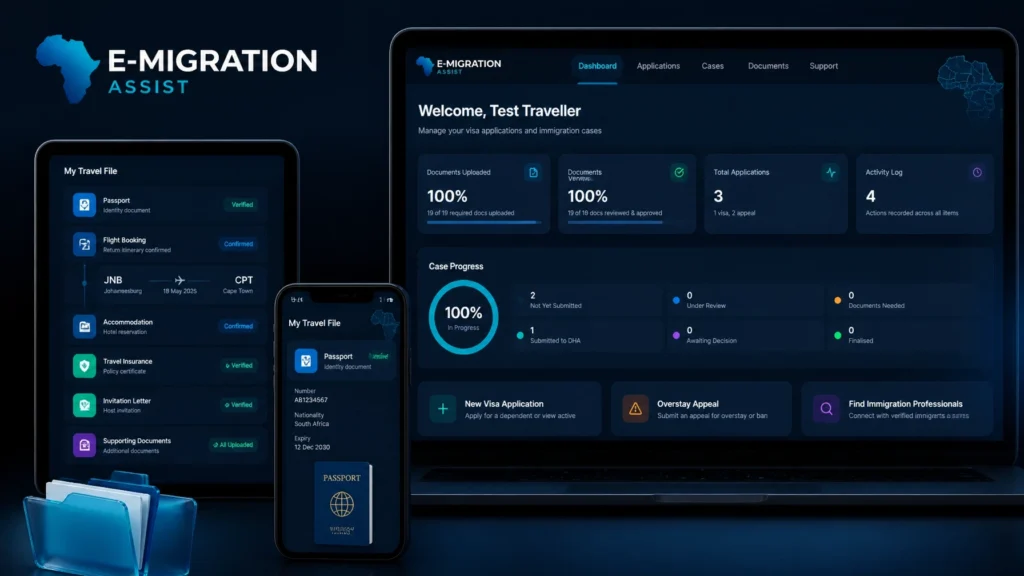
Caption:
Your entry authorisation may be digital. Your preparation still needs structure.
A faster digital entry process can reduce waiting. It cannot answer every question at the border.
Where will you stay?
When will you leave?
What is the purpose of your visit?
Can you show the booking, invitation or supporting record that confirms your answer?
If those documents are scattered across emails, downloads and screenshots, your travel plan is not fully ready. Build a digital travel file before you build your itinerary.
Digital approval is not the same as complete preparation
South Africa’s Electronic Travel Authorisation (ETA) process is designed to make pre-travel administration more efficient for eligible travellers. Applications are completed online. Personal, passport and travel information is submitted digitally. Outcomes are communicated through the applicant’s email and ETA profile.
That is a major improvement on the old way:
: Searching through email threads for the latest confirmation.
: Carrying unrelated paper documents in different folders.
: Forgetting which passport number was used on an application.
: Discovering at the airport that dates do not match.
: Assuming an approval automatically guarantees entry.
The official South Africa ETA FAQ makes an important point: an approved ETA does not guarantee admission. Final admission is determined at the port of entry. Travellers may still be asked for supporting documents, including a valid passport, ETA approval, return or onward ticket, proof of accommodation, an invitation letter where relevant, proof of sufficient funds and a yellow-fever certificate where applicable.
The solution is not more paperwork for its own sake. The solution is a clear record system.
- One file for one journey.
- One current version of every important document.
- One place to check dates, names and passport details.
- One simple view of what is ready and what is still missing.
That is how digital travel becomes controlled travel.
What belongs in a digital travel file?
A digital travel file is a structured collection of records connected to one trip. It should be easy to review before departure and easy to access when you need it.
It does not replace official applications. It does not replace the requirements of a visa, ETA or port of entry. It gives you a practical way to organise the information that supports your journey.
1. Identity and passport records
Start with the document that anchors everything else: the passport you will use to travel.
Keep a secure copy of:
: The passport biodata page.
: The passport number.
: Your full name exactly as it appears on the passport.
: Date of birth and nationality.
: Passport issue and expiry dates.
: Relevant visa or entry-stamp pages, where applicable.
Check every booking and application against this record. A small spelling difference can create confusion. A new passport can also change the document number connected to a digital authorisation.
The ETA FAQ states that passport information is extracted directly during the application process and cannot be corrected afterwards. This makes accuracy at the start essential.
Do not store passport copies in an open, shared folder. Use access controls, strong passwords and a privacy-conscious storage system.
2. Entry authorisation and application records
Add the record that confirms your permission to travel or your application status.
Depending on your circumstances, this may include:
: ETA application confirmation.
: ETA approval email or digital record.
: Visa application confirmation.
: Visa outcome or decision notice.
: Payment confirmation.
: Appointment confirmation.
: Correspondence requesting additional information.
Save the original file where possible. Keep a backup that can be accessed without relying on one email account.
If your journey involves a visa application, record:
: Date submitted.
: Application or reference number.
: Submission channel.
: Expected next action.
: Current status.
: Date of the last update.
This is the foundation of effective visa tracking South Africa. A status page is useful. A complete timeline is better.
3. Transport and onward-travel records
Your digital travel file should show how you plan to arrive and how you plan to leave.
Include:
: Flight or transport itinerary.
: Return or onward ticket.
: Booking reference.
: Arrival airport or port.
: Departure date.
: Internal travel connections.
: Changes, cancellations or reissued tickets.
Make sure the dates align with your accommodation, invitation and declared purpose of travel.
Avoid relying only on a screenshot. Screenshots can become outdated and may not show the full booking details. Keep the confirmation email or downloadable booking document as the primary record.
The goal is simple: if your travel dates change, you should know immediately which other documents need to be reviewed.
A booking is useful only when it matches the story
4. Accommodation records
Proof of accommodation helps establish where you intend to stay during your visit.
Your file may contain:
: Hotel or guesthouse confirmation.
: Rental accommodation details.
: Host invitation letter.
: Host’s address and contact information.
: Check-in and check-out dates.
: Booking reference and cancellation terms.
If you are staying with a host, keep the invitation and relevant supporting records together. If you are travelling between several locations, create a short accommodation timeline rather than storing each confirmation separately.
Check for gaps.
A booking from 1 to 10 September does not explain where you will stay from 10 to 14 September. A host letter with no address or dates may be difficult to use as a practical reference. The details should be clear and consistent.
: The old way: a booking in one email, a host letter in WhatsApp, and dates in a spreadsheet.
- The structured way: one accommodation section with a complete, current timeline.
Less searching. More control.

5. Insurance and financial-support records
Travel insurance is not automatically the same as an immigration requirement. Requirements can differ according to nationality, purpose, visa category, application channel and current official instructions.
Still, keeping your insurance record organised is sensible travel preparation.
Include:
: Policy certificate.
: Policy number.
: Dates of cover.
: Emergency assistance contact details.
: Medical, cancellation or repatriation cover information, if included.
: Exclusions or conditions that you need to understand.
You may also need to keep practical proof of financial support, depending on the requirements that apply to your journey. This could include bank statements, a sponsorship record, an employer funding letter or other supporting evidence.
Only share sensitive financial information through a trusted, secure channel. Do not send full bank statements through informal messaging groups or to unverified contacts.
6. Invitation and purpose-of-visit records
An invitation can help explain the reason for a visit. It should not be treated as a universal substitute for a visa or other requirement.
Where relevant, keep:
: Invitation letter.
: Name and contact details of the inviting person or organisation.
: Purpose of the visit.
: Intended dates and duration.
: Meeting, conference or event details.
: Information about who will cover travel or accommodation costs.
: Supporting identity or organisation records, where requested.
Your purpose of visit should make sense across the whole file. A business invitation, a tourist itinerary and an accommodation booking should not tell three different stories.
For short-term work, business activity or other specialised purposes, check the applicable official requirements. An ETA alone does not authorise work. The official ETA guidance explains that work may require a separate Section 11(2) visitor’s visa and an invitation from a registered entity.
This is not a legal assessment. It is a record-control principle: the documents in your file should accurately reflect what you intend to do.
Do not forget the separate traveller declaration
Entry authorisation, visa documentation and customs declarations are different processes.
The South African Revenue Service traveller declaration guidance states that travellers entering or leaving South Africa by air, land, sea or rail must submit an online traveller declaration, subject to the stated exceptions.
The declaration generally requires:
: Passport or travel-document details.
: Travel information.
: Contact details.
: Travelling-companion information, where applicable.
: Details of goods, currency or negotiable instruments that must be declared.
SARS advises travellers to submit the declaration no more than 24 hours before departure from the country of travel. If the journey includes stops, this applies to the last leg directly to South Africa.
Add the confirmation to your digital travel file. If your details change, update the declaration as required. Keep the confirmation available on your phone and, where practical, in a printable format.
- One file can hold the ETA record.
- One file can hold the SARS confirmation.
- One file can show the current itinerary.
That separation creates clarity. It also reduces the risk of confusing one digital process with another.

A practical 24-hour readiness review
Before departure, complete a short file review.
Identity
: Am I travelling on the same passport used in my application?
: Is the passport valid for the applicable period?
: Are the name and passport number consistent across records?
Entry
: Do I have the correct ETA or visa record?
: Can I access the approval or outcome offline?
: Does the authorisation match my purpose and intended dates?
Journey
: Do I have a return or onward ticket?
: Are all arrival and departure dates correct?
: Have transport changes been reflected in the rest of the file?
Stay
: Can I show where I will stay?
: Do the accommodation dates cover the full journey?
: Do I have the host’s contact details if I am staying privately?
Supporting records
: Is my invitation current and relevant?
: Is my insurance certificate accessible?
: Do I have financial-support records if they are required for my circumstances?
: Do I have a yellow-fever certificate if applicable?
Declarations
: Have I completed the relevant traveller declaration?
: Do I have the confirmation?
: Have I declared goods or currency accurately?
This review is not a guarantee of entry. It is a simple way to replace an overwhelming last-minute search with a controlled readiness check.
A digital travel file should be private, not merely convenient
A passport, booking, insurance certificate and invitation can contain sensitive personal information. Convenience should not come at the cost of privacy.
Use:
: A secure portal or encrypted storage.
: Role-based access for professional teams.
: Clear file names and version dates.
: Multi-factor authentication where available.
: A defined retention and deletion approach.
: Separate access for people who need to review documents and people who only need status updates.
E-Migration Assist provides privacy-conscious infrastructure for travellers and for the firms assisting them. The platform supports structured workflows, secure document handling, requirements checklists, tracking and decision logging. It is not an immigration consultancy and does not replace legal or professional advice.
For individuals, that means a clearer path from document collection to submission. For law firms, immigration consultancies, relocation companies, travel agencies and global employers, it means a more consistent way to manage the records behind multiple journeys.

The faster system needs a stronger record
Digital entry authorisation can improve speed. It does not remove responsibility.
The confident traveller is not the person with the most documents. It is the person who knows:
: Which document is current.
: Which process it belongs to.
: What action is next.
: Where the record is stored.
: Who can access it.
That is the difference between a folder of files and a digital travel file.
Build the structure before you travel. Track the status before it becomes urgent. Keep the records secure. Keep the information consistent.
Less admin. More clarity. More control.
Ready to structure your immigration workflow?
Complete the free profile assessment for individuals, law firms, immigration consultancies, relocation companies, travel agencies and global employers: https://emigration-assist.com/assessment
This article provides general information only. It is not legal advice. Requirements may vary according to nationality, travel purpose, visa or authorisation type, application channel and current official guidance. Always verify the requirements that apply to your circumstances with the relevant South African authority or qualified professional.
SEO keywords: South Africa ETA, electronic travel authorisation South Africa, South Africa visa application, visa tracking South Africa, South Africa travel documents, digital travel file, South Africa entry requirements, proof of accommodation South Africa, South Africa invitation letter, travel insurance South Africa, immigration document management, immigration case management, secure document handling, visa application checklist South Africa
Hashtags:
#SouthAfricaETA #SouthAfricaVisa #ElectronicTravelAuthorisation #VisaTracking #TravelDocuments #DigitalTravelFile #SouthAfricaTravel #GlobalMobility #ImmigrationTech #ImmigrationCaseManagement #SecureDocumentHandling #E_MigrationAssist