


 Check Your Eligibility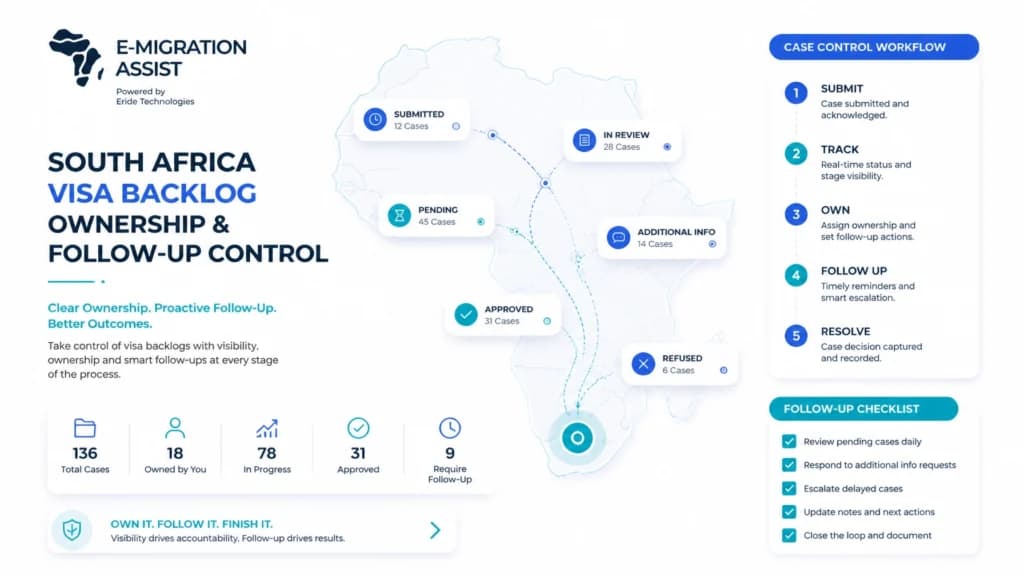
A visa application can be legally pending and still be operationally unmanaged.
That is the risk many employers, employees and immigration professionals miss.
The problem is not only that a case is taking longer than expected. The real problem is what happens during the waiting period:
, Nobody is assigned to check the status.
, No date is set for the next follow-up.
, A critical document remains buried in an email thread.
, The employee assumes the professional is handling it.
, The professional assumes HR has received the update.
, HR discovers the issue only when travel, payroll or onboarding is affected.
A South Africa visa backlog becomes a business risk when delay has no ownership, no escalation path and no reliable record.
The solution is not more spreadsheets. It is a controlled workflow that makes the next action visible.
The backlog is not one single problem
South Africa’s immigration processing environment has changed. The Department of Home Affairs has reported progress in addressing historic visa and permit backlogs. However, delays may still affect certain waiver, long-term visa and appeal applications.
Immigration Directive No. 7 of 2026 provides temporary concessions for qualifying applicants whose applications remain pending. The directive states that certain long-term visa, waiver and appeal applicants may receive an extension of status until 30 June 2027, subject to the stated conditions.
It also makes important limits clear:
, The application must have been submitted through VFS Global with a verifiable receipt.
, Applicants must continue complying with their existing visa conditions.
, Permanent residence applicants are not covered by the same concession.
, Certain visitor visa appeal cases are excluded.
, The concession ends immediately when an outcome is received.
These details matter.
A case cannot be managed safely with a single status label that says “pending”. The record must show:
- What type of application was submitted.
- When it was submitted.
- Which receipt confirms the submission.
- What conditions currently apply.
- Whether the case is covered by a concession.
- Who owns the next follow-up.
- When the next review or escalation must happen.
That is the difference between passive waiting and active case control.

A pending case can create active business exposure
Consider a foreign employee whose long-term visa application is still pending.
The employee may be able to continue working under the conditions of their existing visa. But that does not mean every business decision remains risk-free.
What happens if:
, The employee changes role?
, The employee moves to another location?
, The employee changes employer within the group?
, The employee travels without the right supporting documents?
, The company renews a contract without checking the case position?
, A decision arrives, but nobody sees it promptly?
A pending application requires ongoing attention because the underlying facts can change.
The employee’s work authorisation, travel plans, job description, passport, address and supporting documents may all need to be reviewed. A case that was correctly submitted can become difficult to defend if the business cannot show how it monitored the matter afterward.
This is why visa tracking in South Africa should not mean checking a reference number once every few months. It should mean maintaining a complete operational record from submission to outcome.
The hidden cost of disconnected follow-ups
The old way often looks like this:
, VFS receipt in one email.
, Passport copy in a shared drive.
, HR notes in a spreadsheet.
, Professional correspondence in a separate mailbox.
, Travel plans on a calendar.
, Follow-up reminders in someone’s personal task list.
, Escalation history recorded nowhere.
Each item may exist. The system does not.
When information is fragmented, people spend time reconstructing the case instead of moving it forward. The same questions are asked repeatedly:
“Did we receive the receipt?”
“Who last contacted the authority?”
“Was the employee allowed to travel?”
“Did the outcome arrive?”
“When should we escalate this?”
This creates administrative pressure. It also creates uncertainty for the employee and unnecessary exposure for the employer.
- Centralised documents reduce searching.
- Assigned tasks reduce assumption.
- Due dates reduce forgotten follow-ups.
- Decision logs reduce confusion.
- Shared visibility improves communication.
The end result is less admin and more control.
A practical ownership model
Every case should have one clear owner for the next action. That does not mean one person carries every responsibility. It means each stakeholder knows what they own.
1. The employee owns personal accuracy and responsiveness
The employee should be responsible for providing accurate information and responding promptly to requests.
This includes:
- Supplying valid passport and visa copies.
- Confirming current employment details.
- Reporting changes in role, employer, address or travel plans.
- Keeping copies of submission receipts and relevant correspondence.
- Advising the employer or appointed professional about planned travel.
- Reviewing and acknowledging important updates.
The employee should not be expected to interpret every immigration development alone. They should, however, be able to see what information is outstanding and what action is required from them.
A structured portal turns “please send the document again” into a visible checklist with a clear due date.
2. The employer owns business continuity and internal controls
The employer should own the connection between immigration status and operational decisions.
This includes:
- Confirming the employee’s role and work location.
- Monitoring whether planned duties match current visa conditions.
- Coordinating travel, onboarding and assignment changes.
- Ensuring HR and payroll records reflect the current case position.
- Setting internal review dates before critical deadlines.
- Escalating cases that may affect staffing or delivery.
The employer should not rely on a professional adviser to know about every internal business change. A new project, promotion or relocation can alter the risk profile of a case.
The business needs a reliable workflow for reporting those changes early.
3. The appointed professional owns immigration process coordination
The appointed immigration professional, attorney or authorised adviser should own the professional case process within the agreed scope.
This may include:
- Reviewing the application pathway and supporting documents.
- Confirming submission evidence.
- Monitoring relevant updates.
- Identifying missing information or inconsistencies.
- Advising on appropriate follow-up or escalation.
- Recording material communications and outcomes.
- Explaining when a matter requires legal or specialist advice.
E-Migration Assist does not replace the appointed professional. It provides the infrastructure that helps professionals, employers and employees work from the same structured record.
That distinction matters. The platform supports coordination. It does not make government decisions, guarantee processing timelines or provide a substitute for qualified immigration advice.

The next follow-up should always answer five questions
A useful follow-up record does not need to be complicated. It needs to be complete.
For every pending matter, ask:
-
What is the next action?
For example: check the application status, request a missing receipt or review a decision. -
Who owns it?
Name a person or defined role. Avoid “team” as an owner. -
When is it due?
Use a date, not “soon” or “next week”. -
What evidence is required?
This could be a VFS receipt, rejection letter, appeal confirmation or updated passport. -
What happens if there is no movement?
Define the escalation route and escalation date.
This structure prevents a common failure: confusing activity with progress.
Sending another email is activity. Recording the email, setting a response date and defining the next escalation is case management.
From email chasing to immigration case management software
A spreadsheet can be useful for a small number of cases. It becomes fragile when several stakeholders, visa categories and deadlines are involved.
Immigration case management software should provide more than a list of names and reference numbers. It should create a powered foundation for:
- Visa-type workflows.
- Requirements checklists.
- Secure document handling.
- Case status tracking.
- Reminder and task ownership.
- Communication history.
- Escalation dates.
- Decision logging.
- Portfolio-level visibility for professional firms and HR teams.
The objective is not to automate professional judgment. The objective is to ensure that professional judgment is applied to the right case, with the right evidence, at the right time.
E-Migration Assist gives professional firms and corporate mobility teams a central system for managing cases, documents and clients. Its professional workflow is designed to replace disorganised folders, manual tracking and disconnected communication with structure and visibility.
For individuals, the assessment workflow provides a structured route for visa anomalies, stuck applications and other immigration matters. The platform is designed to handle information securely and prepare a clean record for the next step.
A simple weekly control rhythm
A backlog does not need daily panic. It needs a predictable review rhythm.
A practical weekly cycle could include:
: Monday: Review all cases with actions due that week.
: Tuesday: Request missing documents or confirmations.
: Wednesday: Check status changes and new communications.
: Thursday: Review travel, employment or role changes.
: Friday: Escalate cases with no response and log decisions.
This creates a shared operating rhythm for the employee, employer and professional.
It also makes reporting easier. Instead of asking, “What is happening with our visa cases?”, a mobility manager can see:
- Which cases are awaiting authority action.
- Which cases are awaiting employee documents.
- Which cases require professional review.
- Which cases have a business-critical deadline.
- Which cases have received an outcome.
That is what effective visa tracking South Africa should deliver: not just a status, but a decision-ready view.

The question to ask now
Do not ask only, “How long has this application been pending?”
Ask:
“If an update arrives tomorrow, who will see it, who will interpret the next action, and who will make sure it is completed?”
If the answer depends on searching through email, calling three people or opening an outdated spreadsheet, the case is not fully controlled.
The backlog may be outside your organisation’s control. Ownership is not.
Create a single case record. Assign the next action. Set the date. Store the evidence. Define the escalation. Log the outcome.
That is how a confusing, disorganised process becomes a confident, structured workflow.
For a free profile assessment and workflow solution, visit E-Migration Assist’s assessment page. Employees, employers, immigration practitioners, law firms and corporate mobility teams can use the assessment to identify the right infrastructure for clearer case ownership, secure document handling and compliant workflow management.
Less admin. More control.
This article is for general information and does not constitute legal or immigration advice. Immigration requirements, concessions and processing practices may change. Review the official Immigration Directive No. 7 of 2026 and consult a qualified immigration professional or attorney about a specific matter. See E-Migration Assist’s compliance and disclaimers.
Keywords: South Africa visa backlog, visa tracking South Africa, immigration case management software, South Africa work visa, pending visa application, corporate immigration, global mobility, visa compliance, immigration workflow
Hashtags: #SouthAfricaVisa #VisaTrackingSouthAfrica #ImmigrationCaseManagement #ImmigrationSoftware #GlobalMobility #CorporateImmigration #WorkVisaSouthAfrica #VisaCompliance #EMigrationAssist