


 Check Your Eligibility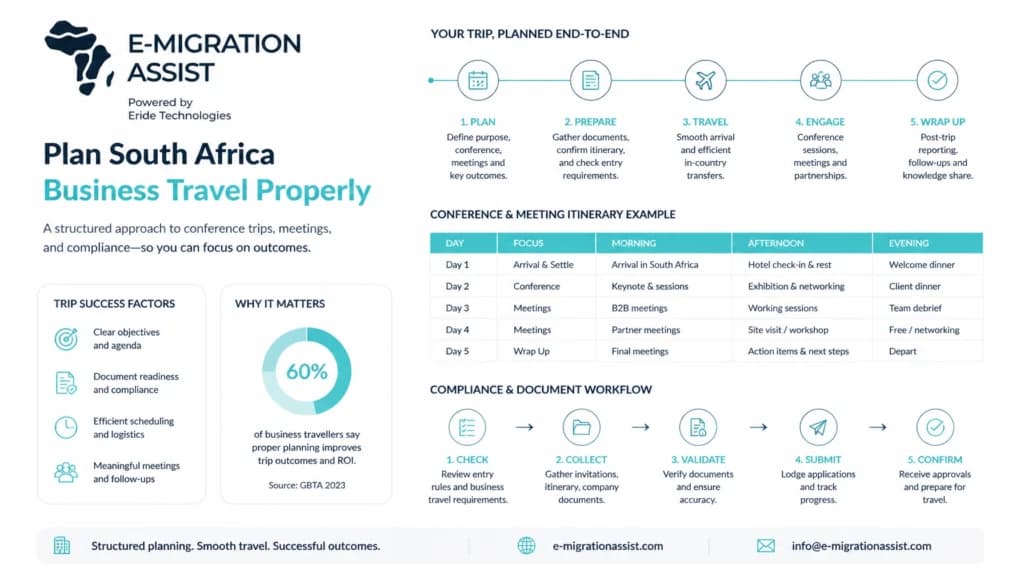
You have a conference invitation. Great. But what exactly will you be doing in South Africa?
Attending? Speaking? Training? Installing equipment? Meeting clients? Performing ongoing work?
Those details matter.
A conference registration confirms an event. It does not automatically confirm that every activity connected to the trip is permitted under the same immigration route.
When planning business travel to South Africa, the safest starting point is not the event name. It is the actual purpose, activity, duration and responsibility attached to the visit.
The problem: one trip can contain several different activities
Business travel often looks simple on a calendar.
: Arrive in Johannesburg
: Attend a three-day conference
: Meet a local partner
: Present at a workshop
: Help install equipment
: Stay for two more weeks to support a project
: Fly home
That is no longer just “attending a conference”.
It may include a business visit, an event participation role and work activity. Each part should be reviewed before travel is booked and before documents are prepared.
The old way is often disorganised:
: A conference organiser sends one generic invitation.
: A traveller relies on a search result for “South Africa business visa requirements”.
: An employer assumes an invitation letter covers all activities.
: A travel agency stores documents across email threads.
: A professional adviser tracks deadlines in a spreadsheet.
This creates uncertainty at the point where clarity matters most.
The solution is a documented purpose-of-travel workflow.
- Identify the real activities.
- Separate attendance from work.
- Record dates, locations and hosts.
- Map the evidence to the proposed route.
- Track changes before departure.
The result is less admin, fewer assumptions and more control.
First, clarify what “business travel” means
When people search for a South Africa business visa, they may be referring to different situations.
At a high level, separate these four scenarios.
1. Short business travel
This can include activities such as:
: Attending a conference or seminar
: Joining a trade event or workshop
: Holding meetings
: Negotiating or discussing commercial arrangements
: Visiting a business partner
: Participating in consultations
The South African Government describes a visitor visa as covering visits for tourism or business purposes, generally for up to 90 days, subject to the applicable rules. Some nationalities may be exempt from visa control for particular short visits.
That does not mean every business-related activity is automatically covered. The traveller’s nationality, intended duration, documents and precise activities still need to be considered.
Check the official South African Government visa guidance and the relevant South African mission before relying on an exemption or preparing an application.
2. Event participation
An event can involve more than sitting in the audience.
Ask:
: Is the traveller only attending?
: Are they speaking or presenting?
: Are they being paid for a service?
: Are they representing a foreign employer?
: Are they demonstrating products?
: Are they operating technical equipment?
: Are they delivering training?
The event organiser should not describe all of these activities as “conference attendance” simply because they happen at the same venue.
The invitation should reflect the real arrangement. It should identify the event, dates, location, host organisation and the traveller’s role. Where relevant, supporting documents should explain who is responsible for expenses and what the traveller is expected to do.
A clear event file helps the traveller, the organiser and the reviewing authority understand the same facts.
3. Short-term work activity
Work activity requires a separate question:
Will the person perform a service, productive task or specific work in South Africa?
Examples may include:
: Installing, repairing or maintaining equipment
: Delivering technical services
: Providing short-term training or instruction
: Working on a commercial production
: Performing specific duties for a South African host
Official guidance for Section 11(2) visitor visa authorisation addresses certain short-term or urgent work activities, including service technicians, trainers or instructors and film crews. It states that the authorisation must be applied for and issued before travel.
This is an important distinction. An electronic travel authorisation, visa exemption or ordinary conference invitation should not be treated as permission to work unless the applicable rules expressly allow the activity.
The exact route depends on the facts. Confirm the current requirements with the relevant South African mission or an appropriately qualified immigration professional.
4. Longer-term employment or business operations
A trip may begin as a conference visit and develop into something longer.
The traveller may be expected to:
: Take up a local role
: Work for a South African employer
: Perform ongoing duties
: Relocate to South Africa
: Establish or operate a South African business
: Remain in the country beyond the original event
That is a change in purpose. It should trigger a new review.
Longer-term employment and establishing or investing in a South African business involve different temporary residence pathways and supporting requirements. A short business visit is not a substitute for the appropriate work or business route.
Do not let a convenient label hide a material change in activity.

What should a documented business travel workflow contain?
A good workflow is not a complicated legal opinion. It is a reliable record of the facts and documents that need to be reviewed.
Step 1: Record the purpose in plain language
Avoid vague descriptions such as “business trip”.
Write:
“The traveller will attend a three-day industry conference, hold two meetings with a South African partner and return to their home country on 8 September.”
If the person will speak, train, install, repair, sell or perform another service, record that too.
Step 2: Build the activity timeline
List each activity by date and location.
- Arrival date
- Conference dates
- Meeting dates
- Work dates, if applicable
- Accommodation period
- Departure date
This exposes problems early. For example, a three-day event may be followed by two weeks of project work that was not mentioned in the original invitation.
Step 3: Identify every responsible party
A business trip may involve several organisations:
: The foreign employer
: The South African host
: The event organiser
: A travel agency
: A client or project owner
: A professional adviser
Each party should understand its role.
Who issued the invitation?
Who pays for flights and accommodation?
Who supervises the activity?
Who pays remuneration or a stipend?
Who is the contact in South Africa?
Clear responsibility supports a credible application and a better travel plan.
Step 4: Map the supporting evidence
Depending on nationality, route and circumstances, supporting documents may include:
: A valid passport
: A completed application form, where a visa is required
: An invitation letter
: Conference registration or event confirmation
: Employer correspondence
: A detailed flight itinerary
: Proof of accommodation
: Proof of financial means
: A yellow fever certificate, where applicable
: Documents explaining the role and duration of any work activity
Requirements can vary by nationality, application location and purpose. The South African mission responsible for the applicant should be checked for current instructions.
Step 5: Add a change-control check
Business travel plans change.
The conference adds a workshop.
The client requests an installation.
The traveller extends the stay.
A second South African host becomes involved.
The employer changes the project scope.
These are not minor administrative updates. They may affect the purpose-of-travel assessment.
A controlled workflow should flag changes before the traveller boards a flight.
Why this matters to event organisers and travel agencies
Event organisers are often the first people asked for an invitation letter. Travel agencies may be asked to assemble the itinerary. Employers may need to confirm the business purpose. Advisers may need to review the complete file.
Everyone benefits from the same structured record.
: Fewer generic invitation letters
: Fewer inconsistent dates
: Fewer missing host details
: Fewer last-minute document requests
: Fewer assumptions about what “business” includes
A central workflow also creates a better traveller experience. People can see what is complete, what is outstanding and what has changed.
That is more useful than sending another long email with ten attachments.

How E-Migration Assist supports the process
E-Migration Assist is technology infrastructure for South African immigration workflows. It is not an immigration consultancy and does not replace qualified legal or immigration advice.
The platform helps travellers, professional firms, employers and mobility teams organise the operational side of a case.
- Create a structured traveller or case profile.
- Capture the purpose and timeline of the trip.
- Organise documents in one secure location.
- Track missing information and review stages.
- Record activity, decisions and case updates.
- Maintain a clearer handoff between stakeholders.
For professional firms and corporate mobility teams, this creates consistency across multiple travellers and events. For individuals, it replaces an overwhelming collection of emails and attachments with a guided structure.
Visit the Traveller workflow to understand the individual experience, or explore the Professional workflow for case management across teams.
The technology does not decide whether a person qualifies or guarantee an outcome. The relevant authorities make immigration decisions. E-Migration Assist provides a powered foundation for accurate information capture, document readiness and operational control. Read the platform’s compliance and disclaimers before relying on any information.
The practical takeaway
A conference is an event.
A business trip is a plan.
Work is an activity.
Employment is a longer-term relationship.
Do not treat these terms as interchangeable.
Before arranging travel to South Africa, document:
: What the traveller will do
: Where they will do it
: When they will do it
: Who invited them
: Who pays and supervises
: Which documents support the plan
: What happens if the plan changes
That is the difference between a hopeful itinerary and a controlled business travel process.
Planning a trip to South Africa? Start with a clearer profile before you commit to a route. Complete a free E-Migration Assist profile assessment and organise the next step with less admin and more control.
Information in this article is general and may change. Visa requirements depend on nationality, activity, duration and individual circumstances. Always verify current instructions with the relevant South African mission and obtain professional advice where required.
Caption:
A conference invitation is not a blank cheque to work in South Africa.
If your trip includes meetings, presentations, training, technical services or ongoing employment, the details matter. Start with the activity: not the event name: and build a documented workflow before you book the flight.
Read the full guide: A Visa for a Conference Is Not a Work Strategy
#SouthAfricaVisa #SouthAfricaBusinessVisa #SouthAfricaVisaRequirements #BusinessTravel #GlobalMobility #ImmigrationCompliance #CorporateMobility #ConferenceTravel #VisaApplication #CaseManagement #E migrationAssist