

 Check Your Eligibility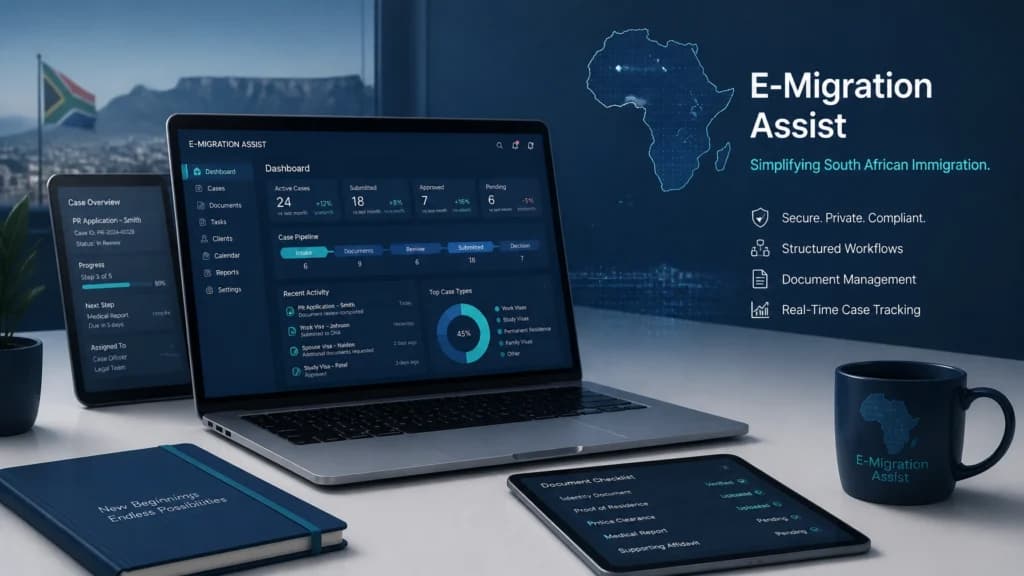
For years, the global mobile workforce viewed South Africa as a bucket-list destination, yet an administrative fortress. The traditional South Africa work permit system was built for a 20th-century economy: one of physical offices, local payrolls, and endless paper trails.
In 2024, that landscape shifted. Under the leadership of Dr. L. A. Schreiber, MP, Minister of Home Affairs, South Africa formally entered the global "Remote Work" race. The Department of Home Affairs (DHA) introduced the Remote Work Visitor Visa: colloquially known as the South Africa digital nomad visa.
If you are a tech-driven professional, a creative freelancer, a foreign employee, or a professional firm supporting cross-border mobility, you are likely asking: which visa category fits this case? The answer lies in understanding the specific legal structures recently codified and those currently being pioneered.
The Nomenclature Confusion: What’s in a Name?
Many applicants are confused by the terms "Digital Nomad Visa" and "Remote Work Visa." In the context of South African law, specifically Section 11(1)(b)(iv) of the Immigration Act, these terms refer to the same operative benefit: the right to live in South Africa while working for an entity located entirely abroad.
However, the distinction becomes critical when you compare this Remote Work Visitor Visa to the Start-up Entrepreneur Visa framework currently being proposed by Dr. L. A. Schreiber, MP, Minister of Home Affairs.
The Problem: The Old Way of Manual Migration
— Disjointed email threads across applicants, advisors, and firms.
— Guessing which income threshold applies this month.
— Zero visibility into where your passport sits in the DHA queue.
— Manual spreadsheets to track the "183-day" tax residency rule.
The Solution: The E-Migration Assist Way
- Centralized, digital case management infrastructure.
- Predefined workflows that support both individual applicants and professional firms.
- Intelligent tracking for every visa stage from submission to decision.
- A privacy-first portal for sensitive financial documentation.
E-Migration Assist is not an immigration consultancy. We are the infrastructure behind a more structured process. For individuals, that means guided clarity. For firms, that means a stronger system for the workflows they already run. Less admin. More control.
Comparison: Remote Work Visa vs. Start-up Entrepreneur Visa
As of 2026, the primary route for nomads is the Remote Work Visitor Visa. However, for those looking to build a local footprint, the Start-up Visa is the rising star on the horizon.

| Feature | Remote Work Visitor Visa (Digital Nomad) | Start-up Entrepreneur Visa (Proposed) |
|---|---|---|
| Primary Goal | Lifestyle & Foreign Earnings | Innovation & Local Growth |
| Income Requirement | ZAR 650,796+ Gross Per Annum | Capital Investment / Points-Based |
| Source of Funds | 100% Foreign Employer/Clients | Local/International Investment |
| Duration | Up to 36 Months | Variable (Path to Residency) |
| Local Hiring | Prohibited | Encouraged/Required |
For most travellers, the South Africa remote work visa is the correct entry point. It requires you to prove that you are not entering the South African labor market, but rather "exporting" your expertise while "importing" your foreign currency into the local economy.
The R650k Threshold: Navigating the Financial Standard
To maintain the integrity of the migration system, the DHA has set a clear financial benchmark. To qualify for the South Africa digital nomad visa, you must demonstrate a gross annual income of at least R650,796.

This is not a suggestion; it is a hard requirement evidenced by three months of foreign bank statements. This is where the process often becomes overwhelming. For individuals, the challenge is knowing what to upload and when. For firms, the challenge is keeping every case consistent across teams. Managing sensitive financial data, meeting DHA standards, and tracking document validity can quickly become disorganized.
E-Migration Assist simplifies this through our Secure Document Handling portal. Instead of relying on insecure email attachments and scattered folders, you work inside a privacy-conscious infrastructure that supports structured uploads, review, and tracking. It strengthens the process for individual applicants and helps professional firms streamline the workflows they already manage.
Why Digital Nomads Demand "Digital Certainty"
Digital nomads are tech-native. They live in the cloud and manage their lives through apps. When they encounter the manual, paper-based legacy of immigration, it creates a friction that can derail a move.
We call this the need for Digital Certainty.
— Unpredictability: Not knowing if your documents are "expired" before they are even reviewed.
— Complexity: Navigating the "Medical" and "Radiological" report requirements without guidance.
— Anxiety: Wondering if the ZAR 650,000 threshold was calculated correctly against your home currency.
- Clarity: A step-by-step requirements checklist that updates in real-time.
- Certainty: Automated tracking that notifies you the moment your case status changes.
- Compliance: Human-reviewed guidance that supports a decision-ready application before it reaches a DHA official.
This is the positioning that matters. Not consultancy. Infrastructure. A supportive system for people applying on their own, and a scalable operational layer for firms handling multiple matters at once. Less friction. More structure.
The Digital Nomad Journey: From Application to Arrival
The process of moving to South Africa on a South Africa work permit (specifically the remote work category) involves four critical digital milestones.

- Strategic Intake: Assessing your income and contract to ensure you meet the R650k gross salary requirement.
- Workflow Activation: Activating the specialized "Remote Work" track within our platform.
- Document Verification: Uploading PCCs (Police Clearance Certificates) and medicals for human review.
- Decision Logging: Archiving your visa outcome and tracking your stay duration for future renewals.
The SARS Factor: Compliance is Your Only Strategy
Living in South Africa for more than six months within a 36-month period triggers specific tax obligations. As emphasized by Dr. L. A. Schreiber, MP, Minister of Home Affairs, the visa is designed to be streamlined, but it does not exempt you from fiscal responsibility.
Nomads who stay beyond 183 days must register with the South African Revenue Service (SARS). Failure to understand this intersection of immigration law and tax law can lead to significant financial risk.
At E-Migration Assist, we treat compliance as the foundation of the process. We are not a consultancy. We provide the Case Management Infrastructure that helps individuals stay organized and helps professional firms run compliant, repeatable workflows at scale. For more on the risks of non-compliance, read our guide on The R100,000 Risk.
Conclusion: Secure Your Process with Structure
The choice between a South Africa remote work visa and any other category is a choice between two different life paths. For the employee or contractor with global clients, the remote work route is the definitive answer.
However, the visa itself is just one part of the process. The real value lies in the system used to manage it. The old way is manual, fragmented, and difficult to control. The new way is centralized, structured, and built for visibility.
E-Migration Assist is the supportive infrastructure layer behind that shift. For individuals, it creates clarity and confidence. For professional firms, it helps streamline existing workflows without losing control of compliance. Less admin. More control.
Ready to streamline your workflow?
Use our case management system to bring structure, tracking, and document control into your existing process.
#DigitalNomad #RemoteWork #SouthAfricaVisa #NomadLife #WorkFromAnywhere #DHA #GlobalMobility #EMigrationAssist