


 Check Your Eligibility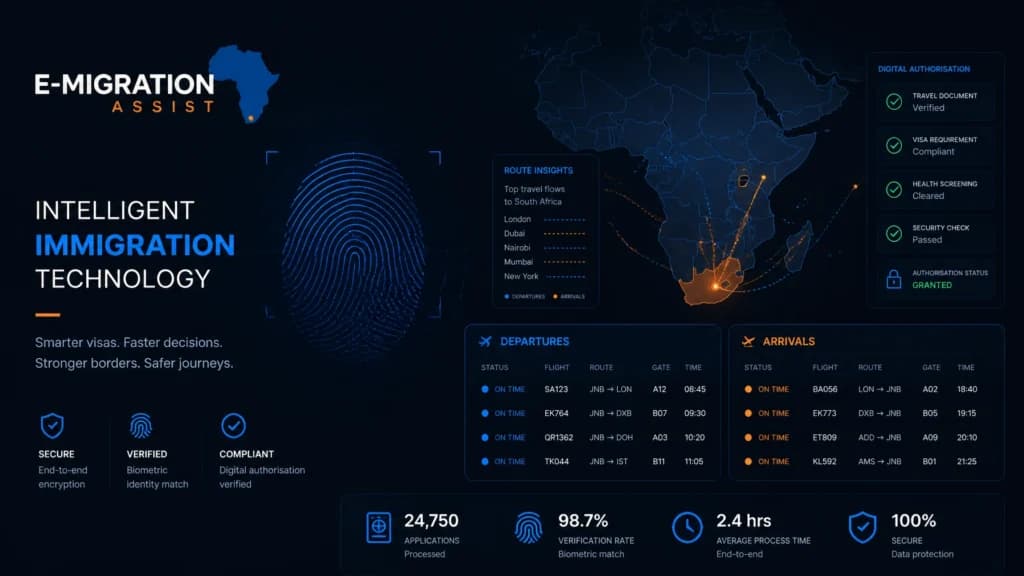
South Africa’s immigration process is moving from paperwork at the counter to digital authorisation before departure. Here is what travellers, employers and immigration professionals need to know now.
South Africa’s Electronic Travel Authorisation is no longer a future proposal.
It is live.
But what does that mean for an actual traveller?
Does it replace a visa? Who must apply? What happens before boarding? What happens at the airport? And what should you do if you are planning a trip before the system expands further?
The short answer is this:
- Eligible short-stay travellers can complete more of the process online before departure.
- Identity and risk checks happen earlier in the journey.
- Entry and exit processing are becoming more connected.
- The traditional visa process has not disappeared for everyone.
The important distinction is between what is confirmed today and what is planned for the next phase.
The old travel experience versus the digital shift
For many visa-required travellers, preparing to visit South Africa has involved a fragmented process.
: Unclear requirements
: Paper forms and supporting documents
: Manual submissions through missions or visa centres
: Limited visibility after submission
: Anxiety about whether the correct document was provided
: Delays that affect flights, accommodation and business plans
The ETA introduces a different structure.
Instead of waiting until arrival for key checks to begin, eligible travellers start with an online profile. Their passport, identity information and travel authorisation are connected before they reach the airport.
That does not remove the need for preparation.
It makes preparation more important.
A digital system can process information quickly, but it still relies on accurate details, a valid passport and the correct travel pathway. The new model is powered by technology, not by guesswork.
Who does the ETA initially affect?
The initial ETA rollout applies to short-stay travellers from four countries:
- China
- India
- Indonesia
- Mexico
These are visa-required markets. Under the initial implementation, eligible nationals travelling for short-term tourism or business purposes can use the ETA process instead of following the conventional visitor visa route.
This does not mean that every traveller from these countries automatically qualifies.
The purpose of the trip, passport validity, personal details, travel history and risk checks still matter. Travellers should confirm their eligibility and the current requirements before making final travel arrangements.
The Department of Home Affairs has also indicated that the ETA will progressively become compulsory for short-stay visitors from additional countries that require port-of-entry visas.
Visa-exempt travellers are expected to gain voluntary access in a later phase. This could allow them to use faster ETA queues or apply for an extension of up to 90 days where permitted.
That expansion is not the same as the initial launch.
For now, travellers should rely on the countries and use cases formally activated by the relevant authorities.
What happens online before you travel?
The process begins on the official ETA platform at eta.dha.gov.za.
The launch process described by Dr. Leon Schreiber, MP, Minister of Home Affairs, includes several digital stages.
1. Create an online profile
The traveller registers using a mobile phone number and email address.
One-Time PIN verification is used to confirm these contact details. This creates a digital profile connected to the traveller’s application.
2. Scan the passport
The traveller scans or uploads their passport.
The system then checks the document against multiple authenticity indicators. According to the official launch address, the passport is assessed against more than 40 parameters.
This is designed to identify potential manipulation or fraudulent documents earlier in the process.
3. Upload a selfie
The traveller provides a facial image.
The ETA system compares the selfie with the photograph contained in the passport. This biometric step is intended to confirm that the person applying is the same person named in the travel document.
4. Complete payment and risk screening
After the required payment step, automated risk analysis is applied.
The system can identify indicators associated with fraud, document concerns or security risks at a speed and scale that would be difficult to achieve through manual checks alone.
This does not mean that every application is decided by an algorithm without oversight. It means that technology supports earlier screening and more consistent processing.
5. Receive the digital authorisation
For approved applicants, the stated objective is to issue the ETA within 24 hours.
The authorisation can be stored in a digital wallet on a smartphone.
Travellers should still keep their passport available and ensure that the details in the authorisation match the passport they will use for travel.

What happens at the airport?
The airport experience is also changing.
At the immigration counter, an approved traveller looks into a camera. Facial verification is then used to confirm that the person arriving is the same person who received the ETA.
The official system is connected to the upgraded Electronic Movement Control System, known as EMCS 2.0.
The practical objective is simple:
- Verify identity at the border.
- Reduce reliance on physical documents alone.
- Detect possible fraud earlier.
- Improve movement records.
- Support faster processing through dedicated ETA counters.
As President Cyril Matamela Ramaphosa and Dr. Leon Schreiber, MP, Minister of Home Affairs, marked the launch on 12 August 2026, the government positioned the ETA as part of a broader modernisation of South Africa’s immigration system.
The system is not only about arrival.
On departure, facial verification can also confirm that the traveller has left South Africa. This creates a more accurate movement record and supports overstay management.
If an expected departure is not recorded, the system may allow the authorities to contact the traveller about a potential overstay.
That makes travel-date tracking a compliance issue: not just an administrative detail.
Where is the system currently available?
The initial airport rollout covers:
- OR Tambo International Airport in Johannesburg
- Cape Town International Airport
- King Shaka International Airport in Durban
- Lanseria International Airport
These airports are the confirmed starting points for the current implementation.
The next phase is expected to extend related facial-recognition and movement-control functionality to land and sea ports. The ETA is also intended to expand to more nationalities and more visa categories over time.
However, future expansion should not be confused with current availability.
Study visas, work visas, spousal visas and other complex immigration categories have not all been replaced by the ETA simply because the platform has launched. The Department of Home Affairs has stated its intention to develop the ETA into a central, end-to-end digital immigration platform.
That is a direction of travel.
It is not a reason to assume that every South African visa application can already be completed through the ETA.
What the ETA does: and does not: replace
The ETA may replace or simplify:
- Some conventional visitor visa processes for initially eligible travellers
- Certain pre-departure manual steps
- Some paper-based identity and document checks
- Part of the arrival process at participating airports
- Some administrative work connected to short-stay extensions
The ETA does not replace:
: A valid passport
: Accurate travel and identity information
: The requirement to meet the conditions of entry
: Visa requirements for categories not yet integrated
: Border admission decisions
: Compliance with the authorised period of stay
: Professional immigration guidance where a case is complex
An ETA is an authorisation to travel under a specific pathway.
It is not a guarantee of entry.
Travellers must still satisfy border officials and comply with South African immigration law. They must also use the same passport connected to the authorisation and monitor the expiry of their permitted stay.
Why organisation still matters in a digital system
Digital immigration is often described as faster.
That is only part of the story.
The real benefit is better structure.
A traveller who stores documents across email attachments, cloud folders and messaging apps can still become disorganised: even when the government process is digital.
A professional firm managing multiple travellers faces an even larger problem.
: Different passport expiry dates
: Different travel purposes
: Different ETA or visa requirements
: Different arrival airports
: Different permitted stay periods
: Different extension and departure deadlines
A central workflow turns these variables into a controlled process.
E-Migration Assist provides supportive case-management infrastructure for individual travellers and the professionals assisting them. It is not a government service and it is not a substitute for an immigration lawyer or registered consultant.
It provides a powered foundation for:
- Requirements checklists
- Secure document handling
- Human-reviewed guidance
- Case status tracking
- Decision logging
- Compliance reminders
- Repeatable workflows for firms and employers
For an individual traveller, that means a clearer path from eligibility assessment to travel preparation.
For a law firm, immigration consultancy, relocation company, travel agency or global employer, it means less dependence on spreadsheets, inbox searches and manual follow-ups.
The new way is centralised, trackable and scalable.
The result is less admin and more control.

A practical ETA checklist for travellers
Before you rely on the ETA for an upcoming trip, confirm:
- +Your nationality is included in the current ETA rollout.
- +Your travel purpose matches the authorised short-stay use case.
- +Your passport details are accurate and current.
- +Your contact details can receive One-Time PINs.
- +Your passport and selfie can be uploaded clearly.
- +Your arrival airport is part of the current rollout.
- +Your authorisation is connected to the passport you will carry.
- +Your permitted stay and departure date are recorded.
- +Your supporting travel documents are organised and accessible.
Do not wait until the airport to discover that your information is incomplete.
The ETA moves key checks earlier. Your preparation should do the same.
The next step: prepare for digital immigration with structure
South Africa’s ETA launch is a meaningful change for short-stay travel.
It can reduce friction.
It can improve identity verification.
It can create better visibility before arrival and after departure.
But the system works best when the traveller’s own process is equally organised.
Whether you are travelling individually or coordinating applications for clients, employees or relocating families, E-Migration Assist helps turn a confusing immigration process into a structured workflow.
Request a free profile assessment and find the right workflow, visa and compliance solution.
Explore the dedicated traveller workflow or see how professional firms can manage cases with structure instead of spreadsheets.
The future of South African immigration is digital.
Prepare with clarity, certainty and control.
This article is provided for general information and does not constitute legal advice or government guidance. ETA requirements, eligible nationalities, fees, processing times and port-of-entry procedures may change. Confirm current requirements through the official Department of Home Affairs announcement and the official ETA platform before travelling.
#SouthAfricaETA #ElectronicTravelAuthorisation #SouthAfricaVisa #SouthAfricaTravel #TravelToSouthAfrica #DigitalImmigration #ImmigrationTechnology #GlobalMobility #VisaCompliance #TravelCompliance #BiometricTravel #ImmigrationCaseManagement #TravelTechnology #EMigrationAssist #AfricaMobility #BusinessTravel #InternationalTravel #RelocationSupport #ImmigrationProfessionals #LessAdminMoreControl
