


 Check Your Eligibility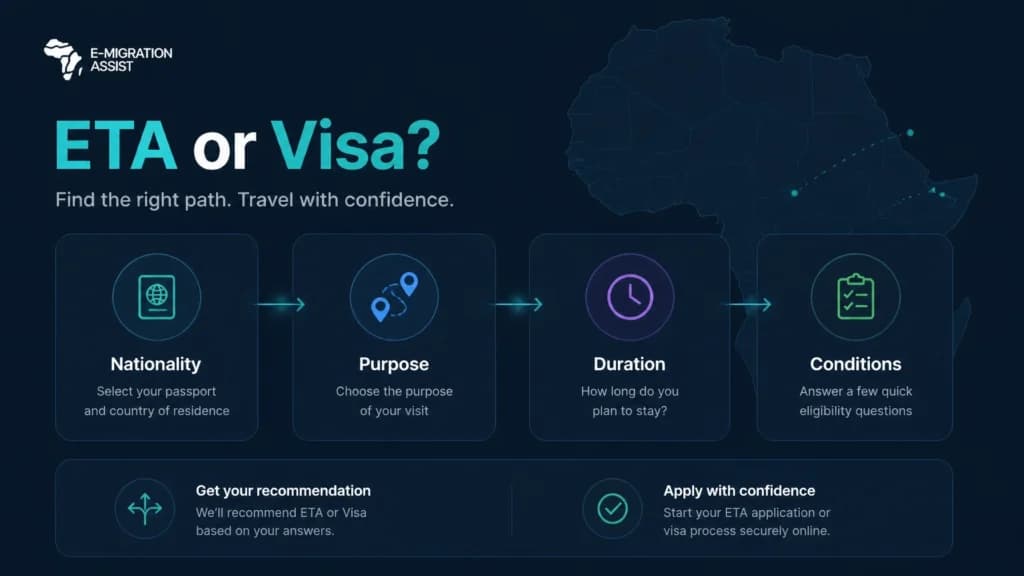
Caption: You have a valid passport. Your flight is booked. But do you know whether you need an ETA, a visa, or neither? The answer depends on more than your nationality. Check the route before you travel: and tell us where the confusion usually starts.
Drafted for 18 August 2026.
South Africa’s new Electronic Travel Authorisation has created a simple question with a complicated answer:
“Do I need an ETA or a visa?”
The answer is not the same for every traveller.
It depends on:
- : Your nationality
- : Your passport
- : Your purpose of travel
- : Your intended duration
- : The conditions attached to your entry
This is where many travellers make the wrong assumption. They see “ETA” and treat it as a replacement for every South African visa.
It is not.
An ETA is one part of South Africa’s changing entry system. A visa exemption is a nationality-based arrangement. A visa is formal immigration permission for a defined purpose and period.
Understanding the difference gives you clarity before departure: and reduces the risk of denied boarding, delays, or entry problems.
First, what is an ETA?
An Electronic Travel Authorisation, or ETA, is a digital travel authorisation linked to your passport.
According to the official South African ETA portal, eligible travellers apply online by providing passport details, travel information, a live photograph and payment where applicable.
The official ETA FAQ explains that the ETA allows an eligible foreign national to travel to South Africa and report to a port of entry.
It is a pre-travel authorisation.
It is not, by itself, permission to:
- : Work in South Africa
- : Study in South Africa
- : Live in South Africa long term
- : Change your immigration status after arrival
- : Ignore the conditions of your entry
For visa-required travellers, the ETA route may result in a Section 10(a) port-of-entry visa. Once the traveller arrives, the relevant visitor’s visa is issued or endorsed at the port of entry.
For visa-exempt travellers, the ETA can be used voluntarily to support more efficient border processing.
That distinction matters.
An ETA helps you travel to the border. It does not automatically determine every right you have after entering South Africa.
What does visa exemption mean?
A visa exemption means your nationality is included in South Africa’s visa-exemption arrangements for specific visits.
If you are visa-exempt, you may generally travel for a short visit without applying for a traditional visitor’s visa before departure. However, visa exemption does not mean unrestricted entry.
You must still meet the applicable entry conditions.
You may be asked to show:
- +A valid passport
- +A return or onward ticket
- +Proof of accommodation
- +Proof of sufficient funds
- +Supporting documents for your stated purpose
- +A yellow-fever certificate, if travelling from a relevant risk country
Visa-exempt entry is usually associated with short visits of up to 90 days, depending on your nationality and the applicable conditions.
The official ETA portal states that visa-exempt travellers may also apply for an ETA. For them, the authorisation is presented as a convenience that may facilitate more efficient processing at the border.
In simple terms:
- Visa exemption: You may not need to apply for a traditional visa before travelling for an eligible short visit.
- Optional ETA: You may choose to obtain digital pre-authorisation for a more structured travel process.
- Entry decision: An immigration officer still determines admission at the port of entry.
A visa exemption is therefore not a blank cheque. It is a limited entry arrangement with conditions.

So, what is a visa?
A visa is formal permission to enter South Africa for a defined purpose and under defined conditions.
The correct visa category depends on what you intend to do.
Examples include:
- Visitor’s visa: For an eligible visit, tourism or other permitted short-term purpose.
- Section 11(2) visitor’s visa: For certain short-term work activities, subject to its specific requirements and restrictions.
- Study visa: For qualifying study in South Africa.
- Work visa: For qualifying employment or work-related activity.
- Spousal or family-based visa: For an eligible family relationship and corresponding purpose.
- Business visa: For qualifying business activity.
The key point is purpose.
A traveller should not choose a visa based only on how long they want to stay. They must also consider what they will do in South Africa.
A 10-day trip for tourism is not the same as a 10-day trip to perform paid work. A 90-day stay is not automatically a work permission. A multiple-entry authorisation is not automatically a residence route.
The E-Migration Assist guide to common visa mistakes highlights one of the most important risks: applying under the wrong category for the activity you intend to conduct.
The right question is not only, “How long am I staying?” It is also, “What am I legally permitted to do?”
The four checks to complete before departure
Before you book your flight: or before you rely on an approval: run four checks.
1. Check your nationality
South African entry rules can differ based on the passport you hold.
Do not rely on:
- : A friend’s experience
- : An old travel forum
- : A previous trip
- : A passport from another country
- : A general statement that “Europeans” or “Africans” do not need visas
Check the current official requirements for your exact nationality and passport type.
A diplomatic, official or temporary passport may be treated differently from an ordinary passport.
2. Check your purpose
Tourism, business meetings, short-term work, study, family visits and residence are not interchangeable purposes.
The official ETA FAQ states that an ETA alone does not permit work.
If you need to work, a separate process and permission may apply. The FAQ refers to a Section 11(2) visitor’s visa for certain short-term work activities, with conditions such as a specific entity, role and duration.
That is different from simply holding an ETA.
If your purpose has changed since your application, do not assume your original authorisation still covers you.
3. Check your duration
An ETA may have a validity period that allows travel or multiple entries. That does not necessarily mean you can remain in South Africa for the entire validity period.
The official FAQ distinguishes between:
- ETA validity: The period during which you may travel to South Africa.
- Visa duration: The period you are permitted to stay after entry.
The length of stay is determined at the port of entry and is subject to the applicable permission and conditions.
Do not confuse:
- : Six months of ETA validity with six months of continuous residence
- : Multiple entries with unlimited stays
- : A possible extension with an automatic right to extend
- : A short visit with a long-term immigration route
4. Check the conditions
Entry permission can have conditions.
Review:
- +Your passport validity
- +Your intended entry date
- +Your permitted length of stay
- +Your number of entries
- +Your return or onward travel
- +Your accommodation details
- +Your financial evidence
- +Any invitation or supporting letter
- +Health documentation where relevant
The official ETA FAQ also states that final admission is determined by an immigration officer at the port of entry. An approved ETA does not guarantee entry if you do not meet the requirements, your purpose has changed, or you cannot provide supporting documentation.

What is the current ETA position in August 2026?
As of 18 August 2026, the official ETA portal states that the system is available for eligible travellers intending to arrive through:
- OR Tambo International Airport
- Cape Town International Airport
- Lanseria International Airport
The portal states that rollout to additional ports of entry will follow.
The official launch address delivered by Dr Leon Schreiber, Minister of Home Affairs, describes a broader rollout plan. It states that the ETA will progressively become compulsory for short-stay visits from countries that require port-of-entry visas. It also describes voluntary access for visa-exempt travellers who want faster processing or future extension functionality.
Planned future scope: not current permission
South Africa’s official launch information describes longer-term plans to expand the ETA platform beyond ordinary short visits.
The planned future scope includes processing more complex categories, such as:
- Study visas
- Spousal visas
- Work visas
- Other digital immigration services
This is a future expansion plan. It should not be treated as current permission to work, study or reside in South Africa through an ordinary ETA.
Always check the live official requirements before applying or travelling.
Where does case management fit in?
The entry decision may be made by South African authorities. But the preparation process still needs structure.
The old way often looks like this:
- : Passport copy in one email
- : Accommodation proof in a WhatsApp message
- : Travel dates in a spreadsheet
- : Application outcome saved somewhere else
- : No clear record of which conditions were checked
The result is an overwhelming and disorganised process.
The better way is a central, reviewable workflow.
E-Migration Assist provides supportive, AI-powered immigration case-management infrastructure for individuals and professional service providers. It helps organise requirements, documents, case milestones and records in one structured environment.
For travellers, the Traveller platform supports:
- +Clear requirement checklists
- +Guided document organisation
- +A structured application process
- +Better visibility over case progress
For immigration practitioners, law firms and corporate mobility teams, the Professional platform supports:
- +Centralised case management
- +Consistent workflows
- +Document tracking
- +Client collaboration
- +Decision logging across multiple matters
The technology does not replace official immigration decisions or professional legal advice. It provides a powered foundation for accuracy, organisation and compliance.
Less admin. More control. A clearer route from eligibility check to departure.
The short answer
If you are asking, “ETA or visa?”, start with these four questions:
- What passport am I travelling on?
- What exactly will I do in South Africa?
- How long will I stay?
- What conditions apply to my entry?
Then confirm the answer through the official ETA portal and the relevant South African immigration guidance.
If the process feels confusing, use a structured assessment rather than guessing. Individuals and professional firms can start with the free E-Migration Assist assessment.
What is the biggest source of confusion for you: the ETA, visa exemptions, permitted activities, or length of stay? Share your question below.
#SouthAfricaETA #ElectronicTravelAuthorisation #SouthAfricaVisa #SouthAfricaVisaRequirements #SouthAfricaEntryRequirements #TravelToSouthAfrica #VisitorVisa #ImmigrationTechnology #GlobalMobility #ImmigrationCompliance #VisaApplication #SouthAfricaImmigration