


 Check Your Eligibility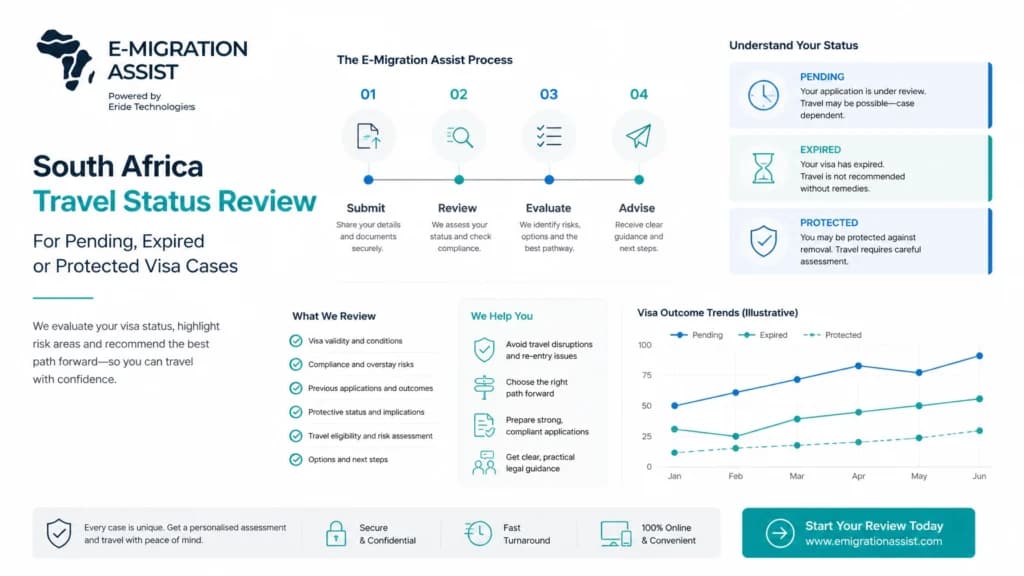
Your application is pending. Your visa has expired. Can you still travel?
The answer is not found in one receipt, one date or one assumption. Before you book a flight, build the full status picture.
A pending application, an expired permission and a temporary concession are not automatically the same thing.
That distinction matters.
: A pending application may prove that something was submitted.
: An expired visa may show that the original permission period has ended.
: A concession may provide temporary protection, but only for defined applicants who meet specific conditions.
The risk is treating these three facts as interchangeable.
The solution is a structured status review.
This article explains the questions to ask before travelling from or returning to South Africa. It is general information, not an individual legal conclusion. Immigration rules and concessions can change. Always confirm the current official guidance and obtain case-specific advice where necessary.
The real problem: one status label rarely tells the full story
“Pending” sounds reassuring.
“Expired” sounds final.
“Protected” sounds complete.
In practice, none of these words is enough on its own.
A traveller may have:
- An application reference number
- An expired original visa
- A temporary concession that may apply
- Conditions that still limit their activities
- Additional requirements for re-entry based on nationality
That is why the first question should not be, “Is my application pending?”
The better question is:
What exactly was submitted, when was it submitted, through which channel, and what does the official record confirm?
That is the difference between an organised travel decision and a confusing last-minute assumption.
Question 1: What was submitted?
Start with the application type.
South Africa’s current temporary concession is set out in Immigration Directive No. 7 of 2026. The directive concerns delayed processing of certain:
: Waiver applications
: Long-term visa applications
: Appeals relating to long-term visa applications
It does not treat every immigration application in the same way.
For example, the directive states that applicants awaiting the outcome of a permanent residence application must keep their residential status valid. Those applicants are not covered by the temporary measures in the directive.
Certain appeals relating to the rejection of a renewal of a visitor’s visa under section 11(1)(a), where the appeal had been pending for longer than three months, are also excluded from the ongoing concession. The directive required those applicants to depart by 30 April 2026 without being declared undesirable.
The point is simple:
A pending application is a description of timing. It is not a complete description of protection.
What to check
Ask:
- Was this a waiver application?
- Was this a long-term visa application?
- Was this an appeal against a long-term visa refusal?
- Was this a permanent residence application?
- Was this a short-term visitor visa application or extension?
- Was this an appeal connected to a visitor visa?
Do not rely on the name used informally by an applicant, employer or travel coordinator. Check the application form, receipt, correspondence and official reference.
- Correct category
- Correct status
- Correct supporting evidence
That structure creates clarity before travel arrangements are made.
Question 2: When was it submitted?
Dates can determine whether a concession applies.
Under Directive No. 7 of 2026, the relevant waiver, long-term visa and appeal applications had to still be pending at the date the directive was signed: 30 March 2026.
The temporary measures took effect from 1 April 2026 and generally extend the relevant status or travel arrangement until 30 June 2027, subject to the directive’s conditions.
This means the following dates should be recorded:
: Original visa issue date
: Original visa expiry date
: Application submission date
: Date on the receipt
: Date the application became trackable
: Date of any refusal or decision
: Date an appeal was submitted
: Date any outcome was received
A calendar is not an administrative extra. It is part of the case record.
An applicant who says, “I applied before my visa expired,” has provided useful information: but not necessarily enough information. The exact application type and the concession’s relevant cut-off requirements still need to be checked.
The same applies to an application submitted after 30 March 2026. It may be pending, but it should not automatically be treated as covered by Directive No. 7 of 2026.
Question 3: Through which channel was it submitted?
The channel matters because the official concession requires more than a personal copy of a form.
Directive No. 7 states that the temporary measures apply only to foreign nationals who were legally admitted into South Africa and who submitted an application through VFS Global with a receipt that can be verified against the VFS tracking system.
That creates three separate checks:
- Was the person legally admitted?
- Was the application submitted through the required channel?
- Can the receipt be verified in the relevant tracking system?
A screenshot, email or scanned page may be helpful. It may not be sufficient by itself.
Keep the original submission record where possible. Keep copies in more than one secure location. Record the reference number exactly as issued. Preserve emails, payment confirmations, appointment records and status updates.
The old way is fragmented:
: A receipt in an email
: A passport copy on a phone
: A payment record in a banking app
: A status update in a chat
: A travel decision made from memory
The structured way is centralised:
- One case record
- One document checklist
- One date timeline
- One activity log
- One place to record professional guidance
That is how less admin becomes more control.
What receipt or proof exists?
A receipt is important. But a receipt does not mean every immigration question has been answered.
It may prove that an application was submitted. It may not prove:
: That the application is still pending
: That the application is the correct category
: That the concession applies
: That the applicant may perform a particular activity
: That the applicant can re-enter without an additional visa
: That no outcome has been issued
For long-term visa appeal applicants, Directive No. 7 specifically requires a copy of the rejection letter together with a receipt or confirmation showing that the appeal was submitted when travelling.
For applicants from countries that are not visa-exempt, the directive also requires a port-of-entry visa before returning to South Africa in the relevant circumstances.
This is where travel planning often breaks down. A traveller may have proof of a pending application but still need to confirm the re-entry requirement linked to their nationality.
Before departure, organise:
- Passport and current or expired visa
- Application receipt
- VFS tracking evidence
- Rejection letter, where an appeal is pending
- Appeal receipt or confirmation
- Any official concession correspondence
- Confirmation of current travel and re-entry requirements
Do not wait until the airport to discover that one document is missing.

What conditions still apply?
A concession is not a replacement visa with unlimited permissions.
Directive No. 7 states that long-term visa applicants and appeal applicants may not engage in activities other than those allowed under the conditions of their current visa.
That means a temporary extension of status does not automatically authorise a new activity.
: A work visa condition is not the same as a study visa condition.
: A study visa condition is not the same as a visitor visa condition.
: A pending application does not automatically create permission to work, study or operate a business.
The original conditions need to be identified and recorded.
There is also an important timing point: the concession ceases immediately when an outcome is received. After that, the applicant must comply with the outcome and its conditions.
A status workflow should therefore include an outcome trigger.
When an outcome arrives:
- Record the date and time received.
- Save the complete outcome notice.
- Identify the decision and its conditions.
- Confirm the next required action.
- Pause travel or activity plans until the position is understood.
That process protects against a common error: continuing to rely on a concession after the case has moved to a new decision stage.
What advice is needed before travel?
Some status questions cannot be answered safely through a generic article.
If the application type is unclear, the receipt cannot be verified, the original visa has expired or a refusal has been issued, case-specific immigration advice may be needed.
Consider asking a qualified immigration professional to review:
: The applicant’s nationality
: The original admission and visa history
: The exact application category
: The submission and expiry dates
: The current tracking record
: The concession requirements
: The proposed destination and return date
: Any work, study or business activity planned during the trip
E-Migration Assist does not replace an immigration attorney, registered adviser or the relevant authorities. It provides supportive case-management infrastructure for individuals and the professionals representing them.
The platform can help organise the record through:
- Structured workflows
- Secure document handling
- Requirements checklists
- Status tracking
- Decision logging
- Human-reviewed guidance pathways
For professionals, this creates a consistent system across multiple traveller files. For individuals, it turns a disorganised collection of emails, receipts and documents into a clear case record.
A practical pre-travel status map
Before you travel, create a three-column review:
| Status question | Evidence to collect | Point to confirm |
|---|---|---|
| What was submitted? | Form, receipt, application category | Whether the category is covered |
| When was it submitted? | Date-stamped receipt and timeline | Whether relevant concession dates are met |
| Through which channel? | VFS receipt and tracking record | Whether the submission is verifiable |
| What permission expired? | Passport and visa copy | Whether the original conditions still matter |
| What protection may apply? | Current official directive | Whether the person meets every condition |
| Can the traveller return? | Nationality and travel documents | Whether a port-of-entry visa is required |
| Has an outcome arrived? | Decision letter or portal record | Whether the concession has ceased |
This is not a substitute for legal advice. It is a way to make sure the right questions are asked before a high-risk decision is made.

The new way to manage pending and expired-status cases
The old way depends on memory, spreadsheets and scattered email threads.
: Dates get missed.
: Receipts become difficult to locate.
: Decisions are not logged consistently.
: Travellers receive different answers from different people.
: Professionals spend valuable time rebuilding the same case history.
The new way uses a powered case-management foundation.
- Centralised records
- Secure folders
- Category-specific workflows
- Review checkpoints
- Travel-document prompts
- Decision history
- Escalation points for professional advice
That structure does not guarantee an immigration outcome. It does reduce avoidable confusion and gives the applicant or professional representative better control over the information required for the next decision.
For current guidance, consult the Department of Home Affairs notices, review Directive No. 7 of 2026, and confirm the position with the relevant official channel before travelling.
Final check: pending is not automatically protected
If your application is pending and your visa has expired, do not stop at those two facts.
Ask:
- What was submitted?
- When was it submitted?
- Through which channel?
- What receipt or official proof exists?
- What conditions still apply?
- What does the current concession actually cover?
- What travel and re-entry requirements apply to your nationality?
- Has any outcome already been issued?
- What professional or official advice is needed?
A structured answer is safer than an assumption.
If you need help turning a complex immigration record into a clear workflow, request a free profile assessment and workflow support from E-Migration Assist.
Less admin. More control. A clearer path before you travel.
SEO keywords: South Africa visa concession 2026, pending visa application South Africa, expired visa South Africa, immigration status before travel, Immigration Directive No. 7 of 2026, South Africa visa re-entry requirements, VFS receipt, overstay immigration South Africa, long-term visa appeal, waiver application South Africa, immigration case management.
#SouthAfricaVisa #SouthAfricaImmigration #VisaApplication #ImmigrationDirective #GlobalMobility #VisaConcession #ImmigrationCompliance #OverstayAppeal #CaseManagement #E migrationAssist #TravelPlanning