


 Check Your Eligibility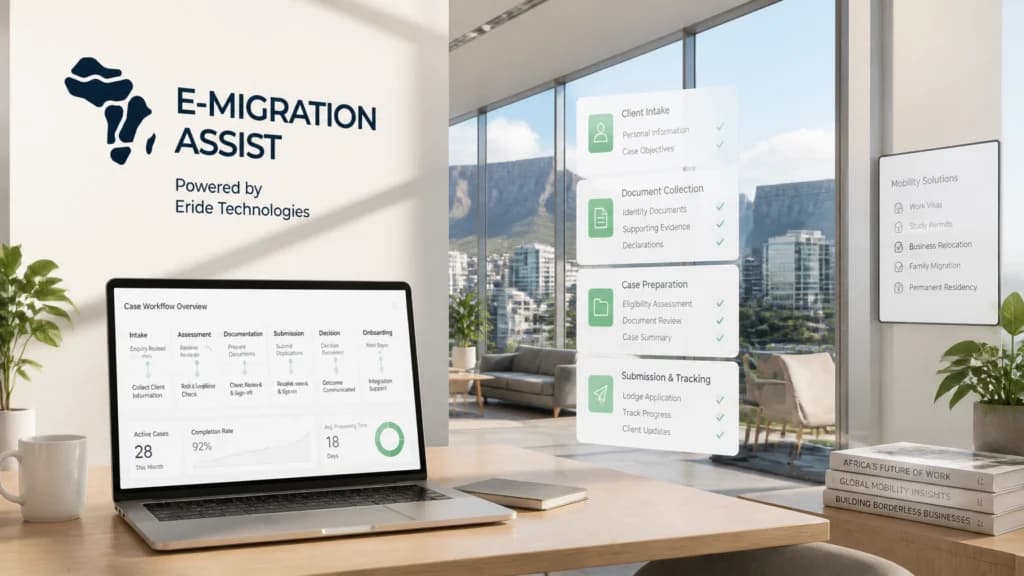
Hook caption: A passport copy is not “just another attachment”. It is an identity document, a trust obligation and a security responsibility. Here is what privacy-conscious immigration document handling should look like in practice.
A passport can be scanned in seconds.
The responsibility attached to that scan lasts much longer.
For an immigration firm, corporate mobility team or individual applicant, a passport copy often sits alongside visa forms, proof of address, bank statements, police clearances, medical records and family information. One case can contain a complete picture of a person’s identity and circumstances.
That makes privacy more than a policy statement.
It becomes a daily operating requirement.
South Africa’s Protection of Personal Information Act 4 of 2013 (POPIA) establishes requirements for processing personal information. The Act addresses security safeguards, retention, access and the responsible handling of information.
But practical privacy is not achieved by ticking a checkbox.
It is achieved through structure.
The old way creates unnecessary exposure
Many immigration processes still depend on a mixture of email inboxes, shared drives, spreadsheets, personal devices and messaging applications.
That approach may feel convenient at first. It quickly becomes difficult to control.
: A passport copy is sent to the wrong email address.
: A document remains in a download folder after the case is closed.
: Several employees have access to every client file.
: A spreadsheet shows more personal information than the team needs.
: Nobody can confirm who opened, downloaded or changed a document.
: A former team member still has access to an old folder.
: Sensitive information is shared through an uncontrolled channel because the process has no clear alternative.
The problem is not always bad intent.
The problem is disorganisation.
When information moves through too many channels, control becomes unclear. When control is unclear, trust becomes difficult to prove.
For a professional service provider, this can affect more than compliance. It can affect client confidence, referrals, operational growth and the ability to manage a larger caseload without increasing risk.
The solution starts with a privacy-conscious workflow
A privacy-conscious workflow does not mean making immigration applications harder.
It means making the handling of sensitive information more deliberate.
- A defined document pathway
- A secure upload point
- Access based on role and responsibility
- A record of important activity
- A clear retention conversation
- A controlled case environment from intake to completion
This is the difference between storing documents and managing them.
A case management platform should help people understand:
- What information has been requested.
- Why it is required.
- Who needs access to it.
- What action is required next.
- What happened during the case.
- What should happen when the case ends.
That structure supports privacy while also creating a more efficient immigration process.
1. Least privilege: access should match responsibility
The principle is simple.
People should only access the information they need to perform their role.
An immigration practitioner may need to review a complete application pack. A finance team member may only need billing information. A coordinator may need to see document status without opening every underlying file.
Giving everyone full access is not efficient control.
It is unnecessary exposure.
: One shared folder for an entire firm
: One password used across a team
: Full document visibility for every user
: No review of access when responsibilities change
A better approach uses role-based permissions and access reviews.
- Give each user the minimum access required.
- Separate client, case and administrative information where practical.
- Remove access when a person changes roles or leaves the organisation.
- Review permissions as the firm grows.
- Keep sensitive documents within the case environment instead of duplicating them across local devices.
E-Migration Assist is designed as infrastructure for both professional service providers and individual travellers. Its professional platform supports centralised case and document management, while its privacy information describes role-based permissions as part of the platform’s data protection approach.
This does not remove the need for internal governance.
It gives that governance a system to operate through.

2. Secure uploads are better than uncontrolled attachments
Email is useful for communication.
It is not automatically a secure document management system.
A passport copy sent as an attachment can be forwarded, downloaded, saved in multiple locations or left inside an inbox indefinitely. Once it moves outside a controlled workflow, it becomes harder to know where it exists and who can access it.
Messaging applications create similar challenges. A client may send a clear photograph of a passport through a personal chat. A team member may then download it, forward it internally and save it to a desktop.
The process feels fast.
The information trail becomes unclear.
A secure document portal creates a defined route for sensitive files.
- The applicant uploads directly into the relevant case.
- The document is mapped to a requirement or workflow stage.
- The professional team reviews it in context.
- Missing or incorrect documents can be identified earlier.
- Unnecessary duplication across inboxes and folders is reduced.
The E-Migration Assist traveller workflow is built around guided document uploads and structured requirements. For professional firms, this means less time searching across channels and less reliance on manual document chasing.
For applicants, it means clearer instructions and fewer questions such as: “Which email address should I use?” or “Did you receive the scan I sent yesterday?”
Privacy and convenience should not be opposites.
A well-designed workflow can provide both.
3. Audit trails turn uncertainty into accountability
A privacy control is more useful when an organisation can verify that it worked.
That is where audit trails matter.
An audit trail records relevant actions within a case environment. Depending on the system and configuration, this may include uploads, reviews, status changes, comments or other case activity.
The value is not surveillance for its own sake.
The value is accountability.
Without a record, a team may struggle to answer basic questions:
- When was the passport uploaded?
- Was the document reviewed?
- Which requirement did it satisfy?
- Was a replacement requested?
- When did the case move to the next stage?
- Was a decision or action logged?
: “I think it was uploaded.”
: “Someone on the team probably reviewed it.”
: “The latest version may be in the shared drive.”
: “We cannot remember when the file was deleted.”
That uncertainty is expensive.
- A central activity record supports continuity.
- A case history reduces repeated requests to the applicant.
- Document status provides operational clarity.
- Decision logging creates a reliable reference point.
- Human reviewers can work from the same information.
E-Migration Assist provides case tracking and activity logging as part of its infrastructure. This supports a more consistent process for firms managing multiple applications and gives individuals a clearer view of progress.
An audit trail does not guarantee that every action is correct.
It does make the process easier to review, improve and control.

4. Retention should be an active decision
A common privacy mistake is keeping everything forever.
The reasoning is understandable:
“We may need it later.”
But indefinite storage increases the amount of information that could be exposed, misused or accessed unnecessarily. It also makes it harder to understand what information an organisation actually holds.
Section 14 of POPIA states that personal information should not be retained longer than necessary for the purpose for which it was collected, subject to applicable exceptions. When an organisation is no longer authorised to retain a record, it must destroy, delete or de-identify it as soon as reasonably practicable.
The correct retention period depends on the context.
It may be affected by:
- The purpose for collecting the document.
- A legal or regulatory requirement.
- Contractual obligations.
- A dispute, investigation or legal claim.
- Whether the information was used to make a decision.
- The organisation’s documented retention policy.
The answer is not always “delete immediately”.
The answer is to make retention deliberate.
- Identify the purpose of each document category.
- Define how long the information should be retained.
- Record the reason for any extended retention.
- Restrict access during the retention period.
- Create a reliable deletion, destruction or de-identification process.
- Review archived information instead of allowing it to accumulate without oversight.
E-Migration Assist’s POPIA Notice explains its commitment to lawful processing, appropriate technical and organisational measures, and retention only for as long as necessary. Its Privacy Policy also describes account, case and technical information handled by the platform.
These pages are useful starting points.
They should not replace a firm’s own privacy policy, retention schedule or professional legal advice.
Privacy supports trust. Trust supports growth.
Professional firms do not grow by adding more uncontrolled folders.
They grow by building repeatable systems.
When clients know where to upload documents, what happens next and how their information is handled, the experience becomes more confident. When internal teams work from one structured case environment, the organisation can manage more applications with less administrative friction.
For individual travellers, privacy-conscious document handling reduces uncertainty during an already overwhelming process.
For immigration practitioners and corporate mobility managers, it supports consistency across teams and cases.
The result is practical:
- Less duplication
- Less document chasing
- Less confusion
- Less unmanaged data
- More clarity
- More accountability
- More control
- More capacity for growth
Technology is not a substitute for sound judgement, lawful processing or human-reviewed guidance.
It is the powered foundation that helps those standards operate consistently.
A passport deserves a system, not a checkbox
If your immigration workflow still depends on email chains, personal downloads, shared passwords and spreadsheets, the issue is not simply administrative inconvenience.
It is a control problem.
Start by asking:
- Where does sensitive information enter the process?
- Who can access it?
- How is access reviewed?
- What activity is recorded?
- How long is each document retained?
- What happens when the case is complete?
- Can the team explain the process to the client with confidence?
A clear answer to each question creates a stronger foundation for privacy and service delivery.
E-Migration Assist provides structured immigration case management infrastructure for individuals and professional service providers. It supports guided document uploads, requirements checklists, case tracking and decision logging for South African immigration workflows.
Ready to replace disorganised document handling with structure and control?
Start your assessment with E-Migration Assist.
This article provides general information and is not legal advice. Organisations should assess their own POPIA responsibilities, contracts, retention requirements and security measures for their specific circumstances.
SEO keywords: POPIA compliance South Africa, secure immigration document handling, passport data security, immigration case management software, secure document portal, South Africa visa application documents, least privilege access, audit trails, data privacy for immigration firms, privacy-conscious immigration platform
Hashtags: #POPIA #DataPrivacy #ImmigrationTechnology #SouthAfricaImmigration #PassportSecurity #DocumentManagement #CaseManagement #GlobalMobility #LegalTech #PrivacyByDesign