


 Check Your Eligibility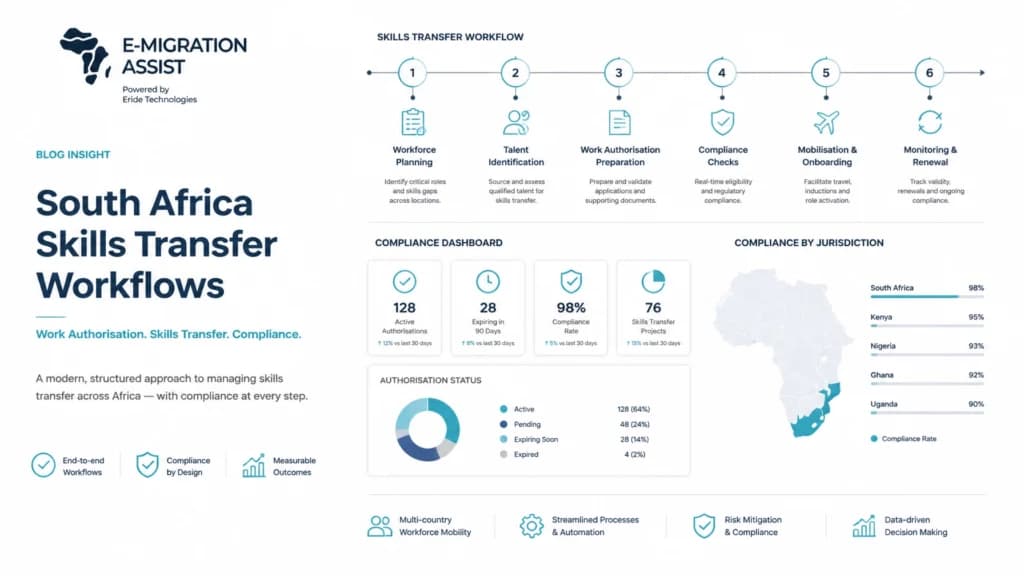
Hook caption: A foreign hire should not be the end of a skills conversation. It should be the start of a measurable workflow.
A foreign employee joins the team.
The project moves forward. The specialist solves a difficult problem. Everyone is relieved.
Then someone asks:
“What skills have been transferred so far?”
The answer is often unclear.
The plan may be in an email. The training schedule may be in a spreadsheet. The work-authorisation evidence may sit in a separate folder. The role requirements may have changed since the visa application was prepared.
That is the problem.
Skills transfer cannot remain a promise made during recruitment. It needs structure, ownership, milestones and evidence.
For employers managing international hires in South Africa, this is becoming increasingly important as the country’s labour-migration policy develops.
The old way: a plan that disappears after approval
Many employers approach skills transfer as a document to prepare once.
They write a short plan. They name an understudy. They list a few training activities. The document is submitted or filed.
Then daily operations take over.
: The foreign employee is assigned to urgent projects.
: The local understudy changes roles.
: Training is postponed.
: The job description evolves.
: The visa or work authorisation approaches expiry.
: Nobody records what was completed.
: Evidence becomes difficult to reconstruct.
This creates an uncomfortable question:
Was the plan implemented, or was it only written?
A document alone cannot answer that question.
A workflow can.
What is changing in South Africa?
South Africa’s labour-migration policy direction has increasingly linked the recruitment of foreign skills to local workforce development, skills planning and knowledge transfer.
The National Labour Migration Policy document discusses the need to attract skills where they are needed while supporting skills transfer, employment creation and development in South Africa.
The policy direction is still evolving. Employers should therefore distinguish between:
: Requirements already applicable to a specific visa category.
: Policy objectives that influence future regulation.
: Proposed statutory duties that are not yet in force.
One important current example is the Intra-Company Transfer Work Visa, where employers may need to provide a defined skills-transfer project plan with timelines and identified skills.
There is also a significant legislative development to monitor.
The Employment Services Amendment Bill, 2026, introduced in the National Assembly, proposes a new Chapter 3A dealing with the employment of foreign nationals.
The Bill proposes that an employer must:
: Ascertain that a foreign national is entitled to work in South Africa and perform the specific work.
: Satisfy itself, in the prescribed manner, that no suitably skilled person in the Republic is available for the vacancy.
: Prepare a skills-transfer plan for any position in which a foreign national is employed, subject to possible exclusions or exemptions.
: Provide employment terms and conditions that are not inferior to those provided to South African citizens.
: Retain copies of relevant visas and other evidence of lawful work authorisation.
These are proposals. The Bill is not automatically law because it has been introduced. Its commencement clause states that it will come into operation on a date fixed by the President by proclamation in the Gazette.
That distinction matters.
Employers should not treat every proposed obligation as an active legal requirement. But they should not wait for final implementation before building the necessary structure.
The new way: turn skills transfer into a controlled workflow
A strong skills-transfer workflow connects five areas that are often managed separately:
- Role requirements
- Local recruitment evidence
- Work-authorisation evidence
- Skills-transfer activities
- Review and decision records
When these elements connect, the employer can see the full position history.
The question is no longer only:
“Do we have a plan?”
It becomes:
“What was the role, why was international expertise needed, what authorisation was held, who was trained, which milestones were completed and what remains outstanding?”
That is a much stronger operating position.

Five practical questions every employer should ask
1. What does the role actually require?
Start with the role.
Not the employee. Not the visa category. The role.
Ask:
: Which technical or professional capabilities are required?
: Which capabilities are currently unavailable or difficult to source locally?
: Is the role temporary, project-based or long-term?
: Which responsibilities are authorised under the employee’s work visa?
: Has the role changed since the original application?
A clear role record creates a reliable foundation for recruitment, authorisation and skills transfer.
Without it, the employer may struggle to show that the position, the employee’s work and the transfer plan remain aligned.
2. What local recruitment evidence exists?
A skills-transfer plan should not replace responsible recruitment.
Employers should record the steps taken to identify suitable people in South Africa, where relevant to the role and applicable process.
This may include:
- Vacancy descriptions.
- Advertising records.
- Candidate assessment notes.
- Reasons for shortlisting or rejection.
- Skills-gap analysis.
- Records of internal candidates considered for development.
The goal is not to create paperwork for its own sake.
The goal is to preserve the reasoning behind the appointment.
3. Who is the understudy or receiving team?
“Skills will be transferred to local employees” is too broad.
A useful workflow identifies:
- The South African employee or team receiving the knowledge.
- The current capability level.
- The skills to be developed.
- The manager responsible for the transfer.
- The expected completion date.
- The evidence that will confirm progress.
The understudy may change. The receiving team may expand. The plan may need to be updated.
That is why skills transfer should be managed as a live workflow rather than a static attachment.
4. Which milestones prove progress?
A milestone should be observable.
For example:
: Technical orientation completed.
: Process documentation delivered.
: Shadowing period completed.
: Supervised task performed.
: Independent task assessed.
: Training session attended.
: Competency review signed off.
: Knowledge base updated.
Employers should avoid vague milestones such as “ongoing mentoring” without a review date or evidence.
A better milestone asks:
What should be different after this activity, and how will we know?
That question creates certainty.
5. Is the work authorisation still aligned?
Skills transfer cannot be separated from immigration compliance.
The employer should track:
- Visa or permit category.
- Sponsoring employer.
- Authorised role and occupation.
- Authorised work conditions.
- Validity dates.
- Renewal or change-of-conditions deadlines.
- Copies of supporting evidence.
- Any decision or review notes.
The proposed Employment Services Amendment Bill would specifically prohibit an employer from requiring or permitting a foreign national to perform work that is not authorised by the relevant visa, permit or law.
Again, this provision is proposed. But the operational principle is already sound:
The work being performed should match the authorisation held.
Why spreadsheets and email threads create risk
Spreadsheets can be useful for simple lists.
They become less reliable when employers manage multiple employees, locations, visa categories, role changes and training milestones.
: Different versions circulate.
: Expiry dates are missed.
: Evidence is stored without context.
: Responsibilities are unclear.
: Updates are not logged.
: Managers cannot see the full case position.
: Reporting becomes a manual reconstruction exercise.
This is not only an administrative inconvenience.
It affects certainty, compliance and growth.
A global mobility team needs one system of record. A law firm or immigration consultancy needs a repeatable workflow for each client. A corporate employer needs visibility across its international workforce.
The technology foundation: organisation before automation
Technology should not replace legal, immigration or human judgement.
It should create the operating structure around that judgement.
An AI-powered case-management system can help employers and professional teams organise:
- Role requirements and vacancy records.
- Document checklists and work-authorisation evidence.
- Skills-transfer plans and training milestones.
- Assigned owners and review dates.
- Expiry alerts and outstanding actions.
- Case status and decision logging.
- Secure records for future reference.
At E-Migration Assist, the focus is infrastructure.
The platform supports global mobility teams, law firms and immigration consultancies with structured case workflows, secure document handling, requirements checklists, tracking and decision records.
E-Migration Assist does not provide immigration consultancy or legal advice. It provides an AI-powered system to help teams manage complex immigration-related processes with greater organisation and control.
Its compliance and disclaimers explain the platform’s role and limitations.

Start before the next policy change
The best time to build a skills-transfer workflow is before it becomes urgent.
Begin with one role.
Ask:
- What is the business need?
- What evidence supports the role requirement?
- What work authorisation is needed or held?
- Who will receive the knowledge?
- Which milestones will be recorded?
- Who reviews progress?
- What happens if the plan changes?
Then create a repeatable workflow for the next role.
This approach gives employers more than a file. It creates an institutional record of how international talent contributes to local capability.
That supports better planning. Better reporting. Better continuity.
Most importantly, it turns skills transfer into something that can be seen, reviewed and improved.
From promise to proof
South Africa’s labour-migration environment is moving toward greater structure around foreign-worker recruitment, local skills development and work-authorisation evidence.
The final requirements will depend on enacted legislation, regulations, exemptions and commencement notices. Employers should monitor official developments and obtain appropriate professional advice for specific matters.
But the operational answer is clear.
: Do not leave skills transfer in an email.
: Do not store authorisation evidence in disconnected folders.
: Do not rely on memory for renewal dates or training milestones.
: Do not treat a plan as complete simply because it was drafted.
- Define the role.
- Record the evidence.
- Assign the people.
- Track the milestones.
- Review the authorisation.
- Log every decision.
That is how employers move from uncertainty to control.
That is how skills transfer becomes a workflow, not a promise.
Ready to organise your immigration and global-mobility workflow? Request a free profile assessment and workflow solution from E-Migration Assist.
More structure. Less admin. More control.
SEO keywords: South Africa skills transfer plan, Employment Services Amendment Bill 2026, South Africa labour migration policy, foreign worker compliance South Africa, work authorisation evidence, global mobility case management, immigration case management software, South Africa work visa compliance, skills development workflow, employer immigration compliance.
Hashtags: #SouthAfricaImmigration #LabourMigration #SkillsTransfer #WorkVisaCompliance #GlobalMobility #ImmigrationTech #CaseManagement #EmploymentServicesAmendmentBill #SouthAfricaWorkVisa #EMigrationAssist
This article is provided for general information and does not constitute legal or immigration advice. The Employment Services Amendment Bill, 2026 remains a proposal unless and until enacted and brought into operation. Requirements may change. Employers should verify current requirements and seek advice from an appropriately qualified professional for their circumstances.