


 Check Your Eligibility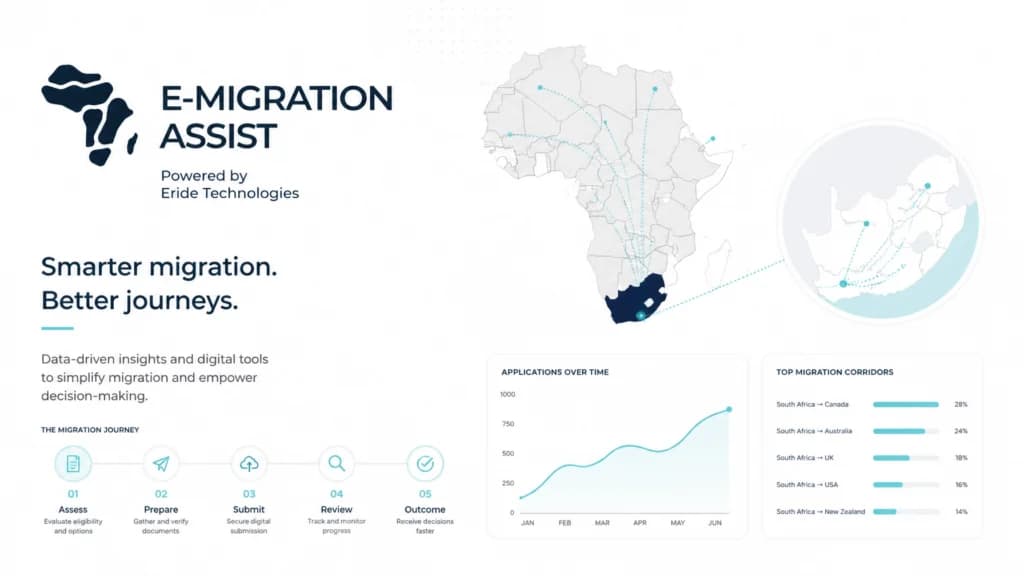
Drafted for 29 August 2026
Hook caption:
South Africa’s immigration process is moving from paper and queues to passports, biometrics and digital authorisations.
That sounds simpler.
But for employers, mobility teams and immigration professionals, it also creates a new question:
Can you see the full status of every person travelling for your business?
: Who is travelling?
: What is the purpose of the trip?
: Which authorisation or visa supports the activity?
: When does it expire?
: Where are the invitation letters, passport records and approvals?
: What happens if the trip changes?
The border may be becoming more digital. Your internal mobility process must become more structured too.
The shift is already underway
South Africa’s Electronic Travel Authorisation, or ETA, was officially launched on 12 August 2026 as part of the Department of Home Affairs’ broader digital transformation programme.
The current system is designed to move key steps online. Travellers create a profile, submit passport and travel information, complete the required identity checks, make payment where applicable, and receive an outcome electronically.
At the border, biometric verification is intended to confirm that the person presenting themselves is the same person who received authorisation to travel.
This is part of the broader Home Affairs @ Home direction. The objective is clear: move selected services away from paper-based administration and physical queues, and toward secure digital access.
For business mobility, this matters because travel authorisation is no longer only a document question.
It is becoming a data, identity and status question.
What is operational now?
The ETA is currently available for eligible short-term travel. The official ETA FAQ states that eligible travellers may apply for visits of up to 90 days, including tourism and certain short-term work activities.
Applications are completed online and may include:
- Personal and passport details
- Travel information
- Payment, where applicable
- Digital submission
- An outcome communicated by email and stored in the traveller’s ETA profile
The official FAQ currently lists implementation at:
- OR Tambo International Airport
- Cape Town International Airport
- Lanseria International Airport
However, the official launch address states that the initial airport rollout includes King Shaka International Airport as well.
That difference is important.
The rollout is active, but businesses should not treat every future capability as universally available today. Nationality, purpose of travel, visa status and port of entry still matter.
The safest approach is to confirm the latest requirements through the official ETA portal and its FAQ before every trip.
ETA does not mean “work permission”
This is where business travel planning needs precision.
An ETA is a digital travel authorisation. It does not automatically give a person permission to work in South Africa.
The official FAQ distinguishes between travel authorisation and the relevant visitor visa issued or recorded for the visit. For short-term work under Section 11(2), the traveller must be invited by a registered entity and the work must be linked to a specific employer, role and period.
That creates a practical distinction:
Business travel may include:
- Meetings
- Conferences
- Negotiations
- Site visits
- Commercial discussions
- Short-term activities permitted under the relevant immigration conditions
It may not automatically include:
: Performing productive work without the correct authorisation
: Changing the employer or role without approval
: Assuming a 90-day entry period covers every type of activity
: Treating an ETA approval as a guarantee of admission
: Allowing a traveller to remain after the relevant permission expires
A traveller may be approved to travel and still be refused entry if the purpose of the visit has changed or the supporting records are insufficient.
That is why the business needs more than a booking confirmation.
It needs a controlled record of purpose, status, conditions and expiry.
Biometrics change the risk conversation
The new border environment is designed to connect the person, the passport and the digital authorisation.
According to the official launch information, the ETA process includes passport scanning and a live selfie. Biometric technology compares the passport photograph with the facial image. The passport is also checked against multiple authenticity parameters.
At arrival, facial verification is used again.
The intention is to reduce identity fraud and improve movement control. It also means that inaccurate or outdated business records can become more significant.
Consider a common scenario.
An employee is scheduled to attend a project meeting in Johannesburg. The meeting changes. The employee is now expected to supervise an installation for several weeks. Their return flight is moved. The passport is renewed. The original invitation letter still reflects the old dates.
The travel booking may be updated.
But has anyone updated the immigration record?
: A changed purpose may create a compliance concern.
: An expired passport may affect an authorisation.
: An outdated invitation letter may no longer support the activity.
: A missed departure date may create an overstay risk.
- A central workflow makes each change visible.
- A document checklist shows what must be updated.
- An expiry tracker creates an early warning.
- A decision log records what was reviewed and when.
This is the difference between storing documents and managing a mobility case.

The real business question: can you see the whole journey?
Digital government systems may hold official immigration records.
But your organisation still needs its own operational view.
Can your team answer these questions in minutes?
- Who is currently in South Africa?
- Who is travelling within the next 30 days?
- Which employees are travelling under visitor status?
- Which employees require a work visa or Section 11(2) authorisation?
- Which passports are approaching expiry?
- Which permissions expire before the planned return date?
- Which invitation letters are still valid?
- Which cases are waiting for documents?
- Which records have been reviewed by a responsible team member?
- Which decisions or changes have been logged?
If the answer requires searching email threads, spreadsheets, shared drives and messaging applications, the process is already exposed.
The old way is familiar:
: A spreadsheet for travel dates
: An email chain for supporting documents
: A shared folder for passports
: A calendar reminder for expiry dates
: Manual follow-ups when something changes
The new way is controlled:
- One case record
- One secure document space
- One requirements checklist
- One status view
- One activity and decision log
The result is not simply better administration.
It is less uncertainty when a person is already travelling, a project is under pressure or a border requirement changes.
Where E-Migration Assist fits
E-Migration Assist does not replace the Department of Home Affairs, an immigration practitioner, an attorney or an immigration consultancy.
It provides the infrastructure around the process.
That makes it useful for:
- Global employers
- Corporate mobility managers
- Relocation companies
- Travel agencies
- Law firms
- Immigration consultants
- Professional firms managing multiple travellers and applications
The platform gives teams a structured environment to manage South African immigration cases, documents and records. The official decision remains with the relevant authority. Professional advice remains with the qualified adviser.
E-Migration Assist helps everyone work from the same organised file.
Through E-Migration Assist for professionals, teams can use:
- Structured workflows aligned to visa types
- Secure document collection and review
- Requirements checklists
- Client and employee collaboration
- Real-time case tracking
- Activity and decision logging
- Submission-ready application packs
This is especially important as the official system becomes more digital. A digital authorisation does not remove the need for internal controls. It increases the value of accurate records.

Prepare for the next phase without confusing it with the current phase
The ETA is not intended to remain limited to short-term visitor travel.
The official launch information describes a future direction in which the platform may expand to more complex categories, including study, spousal and work visas. Additional ports of entry, facial recognition capability and broader digital immigration services are also part of the planned transformation.
Those are important signals.
They are not a reason to assume that every visa category has already moved online or that every traveller can use the same route.
For now, employers should build a process that can handle both systems:
Current requirements
- Existing visa categories
- ETA applications where eligible
- Passport and identity records
- Invitations and supporting documentation
- Port-of-entry conditions
- Expiry and renewal dates
Future readiness
- Digital authorisation records
- Biometric identity checks
- Electronic status updates
- Centralised movement information
- Automated reminders
- A complete audit trail
Businesses that wait until every government service is fully digital may still be managing their people through disconnected tools.
Businesses that build structured internal infrastructure now will be ready to adapt as official channels develop.
A practical readiness check
Before the next employee travels to South Africa, ask:
- Is the traveller’s nationality and purpose of travel confirmed?
- Is the correct visa or authorisation route documented?
- Are passport validity dates recorded?
- Is the invitation or supporting letter current?
- Are the permitted activities clearly stated?
- Is the expected departure date tracked?
- Is there a named person responsible for monitoring the case?
- Are changes to the trip recorded?
- Can the team retrieve every supporting document securely?
- Is there an escalation process if the status or itinerary changes?
If the answer to several questions is “we need to check,” your mobility process needs more structure.
The border is changing. Your records must keep up.
South Africa’s digital immigration direction is designed to make legitimate travel more secure and more efficient.
For business, the opportunity is significant.
- Faster access to information
- Clearer identity verification
- Better movement visibility
- Reduced document friction
- More consistent mobility planning
But digital borders do not solve disorganised internal processes.
They make structure more important.
A business-ready mobility system should show who is travelling, why they are travelling, what status supports the trip, when that status expires and which records support the decision.
That is where E-Migration Assist provides value: a powered case-management foundation for the professionals and organisations responsible for South Africa immigration workflows.
Less admin. More control. Better readiness for the digital border.
Assess your current immigration workflow with E-Migration Assist
For professional firms, book a platform demo.
This article is for general information only and does not constitute legal or immigration advice. ETA availability, visa requirements, port-of-entry procedures and digital rollout arrangements may change. Confirm current requirements through the relevant official authority or a qualified immigration professional.
SEO keywords: South Africa ETA 2026, South Africa electronic travel authorisation, South Africa business travel visa, South Africa short-term work visa, Section 11(2) visa, biometric border checks South Africa, digital immigration South Africa, Home Affairs @ Home, corporate mobility South Africa, global mobility case management, employee relocation South Africa, immigration compliance software.
#SouthAfrica #BusinessTravel #GlobalMobility #CorporateImmigration #ElectronicTravelAuthorisation #ETA #ImmigrationCompliance #BiometricSecurity #DigitalTransformation #HomeAffairsAtHome #VisaTechnology #EMigrationAssist