


 Check Your Eligibility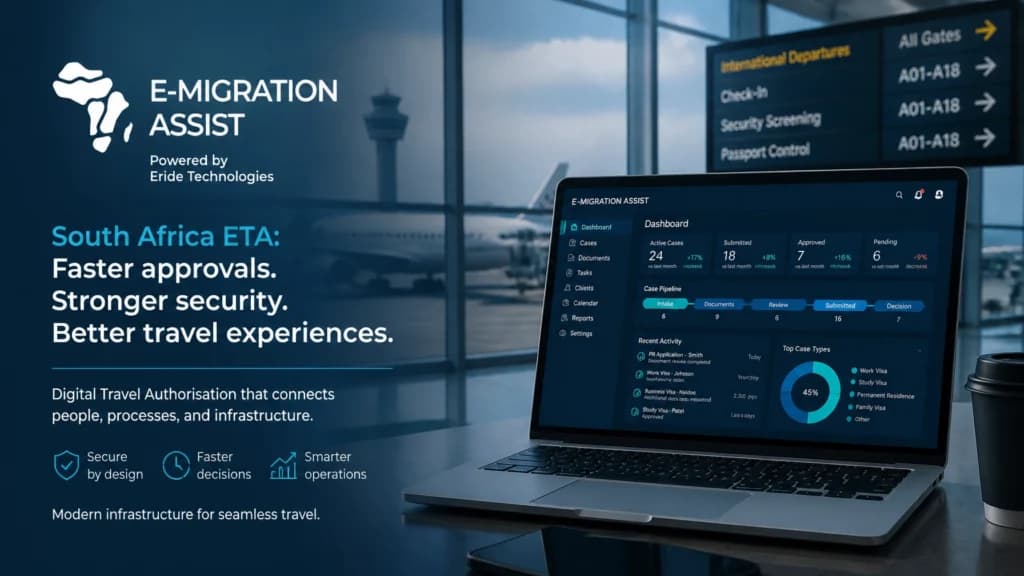
A trip to South Africa may no longer begin with a long visa application, a pile of paperwork, and uncertainty about whether your documents are ready.
On 12 August 2026, South Africa launched its Electronic Travel Authorisation, or ETA. The system is designed to move eligible short-stay travel authorisation online.
The headline is simple:
Approved applicants may receive an ETA within 24 hours.
But what does that actually mean for your next trip?
It does not mean every traveller can use the system. It does not replace every visa category. It does not guarantee entry at the border.
It does mean that South Africa’s immigration process is moving towards a more digital, biometric, and data-led model.
For travellers, firms, and global mobility teams, the practical response is not to rely on a headline. It is to build a clear system for checking eligibility, recording decisions, and monitoring travel conditions.
The old problem: travel plans built around uncertainty
Many travellers know the familiar process:
: Find out whether a visa is required.
: Search for the correct South Africa visa requirements.
: Gather supporting documents from different locations.
: Complete forms manually.
: Wait for updates through email.
: Hope that nothing changes before departure.
This process can feel confusing and overwhelming. A missing document or incorrect passport detail can create unnecessary delays.
Professional firms and relocation teams face the same problem at greater scale:
: Multiple travellers with different nationalities.
: Different passport expiry dates.
: Different travel dates and conditions.
: Documents spread across email, spreadsheets, and messaging platforms.
: No single record of what was checked, approved, or communicated.
The result is administrative risk.
+ The ETA introduces a digital entry point. A structured case workflow turns that entry point into control.
What the South Africa ETA does
The South Africa Electronic Travel Authorisation is a digital authorisation for eligible travellers who intend to visit South Africa for permitted short-stay purposes.
According to the official ETA portal, eligible visa-required travellers may apply online for tourism or visitor purposes without applying for a traditional visitor’s visa. Visa-exempt travellers may also be able to use an ETA for more efficient processing, depending on the applicable rules.
Applications can be submitted online from abroad. The process includes:
: Creating an online profile.
: Providing details about the passport that will be used for travel.
: Answering questions about the traveller and the trip.
: Uploading or scanning passport information.
: Completing a live biometric image or selfie.
: Paying the relevant fee.
: Submitting the application digitally.
If approved, the ETA may be issued within 24 hours. The traveller can then store it in a digital wallet on a smartphone.
That is the convenience.
The important qualification is this: 24 hours is not an approval guarantee. The timeframe applies to approved applications. Travellers should still apply early, use accurate information, and confirm the latest requirements before booking or travelling.
Biometrics and automated risk analysis change the process
The ETA is not simply a digital version of a paper form.
The system uses biometric verification and automated risk analysis. The official launch address by Dr. Leon Schreiber, MP, Minister of Home Affairs, explained that applicants scan their passport and upload a selfie. The system compares the passport photograph with the facial image to verify identity.
It also checks passport information against multiple authenticity parameters. Automated risk analysis then assesses indicators of fraud or risk.
At the border, biometric verification is used again. The purpose is to confirm that the person arriving is the person linked to the authorisation.

This has two direct consequences.
For legitimate travellers:
- Identity verification can happen earlier in the process.
- The authorisation is linked to the passport used for travel.
- Digital storage can reduce dependence on paper documents.
- Border processing may become more efficient at participating airports.
For fraudulent applications:
: Manipulated documents can be identified earlier.
: Identity mismatches can trigger risk review.
: Fraud indicators can be assessed before arrival.
: A digital record can support more consistent decision-making.
During the pilot, 216,204 applications were processed and 6,126 fraudulent applications were rejected, according to SAnews and official government communications.
The lesson is clear: digital convenience comes with digital scrutiny. Accuracy matters more, not less.
Where the initial rollout applies
The initial rollout is phased.
Launch communications identified four participating airports:
: OR Tambo International Airport.
: Cape Town International Airport.
: King Shaka International Airport.
: Lanseria International Airport.
The pilot involved travellers from China, India, Indonesia, and Mexico. Country eligibility and airport availability may expand in stages.
This is why travellers should not rely on an old article, a social media post, or a third-party summary. Check the official ETA portal for the current position before travelling.
Confirm:
- Whether your nationality is eligible.
- Whether your passport type is accepted.
- Whether your intended airport is included.
- Whether your purpose of travel falls within the ETA scope.
- Whether your ETA is linked to the correct passport.
- Whether your travel dates and conditions remain consistent with the authorisation.
The rollout is designed to grow. But phased availability means that eligibility is a live operational question.
What the ETA does not allow
An ETA is not the same as a visa.
It is also not:
: A guarantee that you will be admitted into South Africa.
: A substitute for every South Africa visa application.
: Permission to work in South Africa.
: Permission to study or relocate under a short-stay travel category.
: A decision that overrides border officials or immigration law.
: A general authorisation for repeated extended stays.
The official ETA portal states that work in South Africa is not permitted on an ETA.
Travellers who need to work, study, join a spouse, establish residence, or undertake another activity outside the approved short-stay purpose must assess the appropriate visa or permit route.
The government has indicated that broader categories, including study visas, spousal visas, and work visas, are planned for future expansion of the digital platform. They should not be treated as already available through the ETA.
This distinction is essential.
**+ Use the ETA for eligible short-stay travel.
- Use the correct visa or permit category for work, study, family, or residence purposes.
- Record the decision and conditions before travel.**
Clarity at the start reduces compliance problems later.
The records every traveller should keep
A digital authorisation is useful only when its details can be retrieved and verified.
Every traveller should keep a clear record of:
: The passport number used in the application.
: Passport issue and expiry dates.
: The application reference or profile details.
: The approved ETA.
: The date of approval.
: Intended arrival and departure dates.
: The purpose of travel.
: Any conditions attached to the authorisation.
: Supporting documents submitted.
: Relevant communication or requests for further information.
Keep the passport and ETA details consistent. If you renew your passport, change your travel plans, or alter the purpose of the trip, check whether a new application or updated assessment is required.
Do not assume that a digital wallet entry removes the need for good records. Store supporting information securely and keep access available while travelling.
What professional firms and global employers should monitor
The ETA also changes the operating model for immigration practitioners, law firms, relocation companies, travel agencies, and global employers.
The old way is familiar:
: A spreadsheet for traveller details.
: An email thread for documents.
: A calendar reminder for departure.
: A separate folder for approvals.
: Manual follow-up when conditions change.
That model becomes harder to control as volume increases.
The new model should centralise the case:
- Eligibility assessment.
- Passport and identity details.
- Application status.
- Approval record.
- Travel dates.
- Conditions and permitted activities.
- Supporting documents.
- Client or employee communications.
- Decision logs and follow-up actions.

This is where case management infrastructure becomes valuable.
E-Migration Assist is an AI-powered online immigration case management system and digital infrastructure. It does not issue ETAs. It does not make government decisions. It does not guarantee approval. It is not an immigration consultancy or legal adviser.
It supports individuals and professional service providers through:
- Structured workflows.
- Secure document handling.
- Requirements checklists.
- Human-reviewed guidance.
- Case status tracking.
- Decision logging.
- Centralised records for repeatable processes.
For individuals, this can turn an overwhelming application into a structured checklist.
For professional firms, it can reduce disorganised documents, manual tracking, and repeated status questions.
For relocation companies, travel agencies, and global employers, it can create a consistent record across multiple travellers and destinations.

The platform supports the process around the official application. The traveller or professional provider remains responsible for using the correct government channel and complying with the applicable rules.
That separation matters. Technology should provide structure and visibility without overstating what it can decide.
What this means for African global mobility
South Africa’s ETA is part of a wider movement towards digital immigration, biometric identity verification, and data-led border management across Africa.
For travellers, this can mean faster and more accessible processes.
For businesses, it creates a stronger need for compliance records.
For professional service providers, it creates an opportunity to replace fragmented administration with scalable infrastructure.
The winning process will not be the one that simply submits information quickly. It will be the one that can answer clear questions:
: Was the traveller eligible?
: Which passport was used?
: What was approved?
: What were the conditions?
: When may the traveller enter and leave?
: Which documents support the decision?
: Who reviewed the case?
: What action is required next?
The ETA may reduce friction at the application stage. A reliable case system reduces friction across the full immigration journey.
Less admin. More control. Better compliance.
Ready for the digital immigration shift?
Whether you are an individual traveller, immigration practitioner, law firm, relocation company, travel agency, or global employer, the next step is to understand how the ETA affects your profile, workflow, and compliance obligations.
E-Migration Assist can help you organise immigration, visa, permit, and supporting-document workflows through a privacy-conscious, structured system.
For a free assessment of your profile and circumstances, and to explore infrastructure solutions for streamlining your immigration processes, visit:
Start your free assessment with E-Migration Assist
For more guidance, explore the Traveller platform, the Professional platform, and our immigration compliance solutions.
Information in this article is based on official South African government communications available at publication. ETA eligibility, airport availability, requirements, and immigration rules can change. Verify the latest position through the official ETA portal before travelling. E-Migration Assist does not issue ETAs and does not provide legal advice.
#SouthAfricaETA #SouthAfricaElectronicTravelAuthorisation #SouthAfricaVisaRequirements #SouthAfricaVisaApplicationTracking #AfricanGlobalMobility #ImmigrationTechnology #GlobalMobility #TravelToSouthAfrica #ImmigrationCompliance #VisaCaseManagement