


 Check Your Eligibility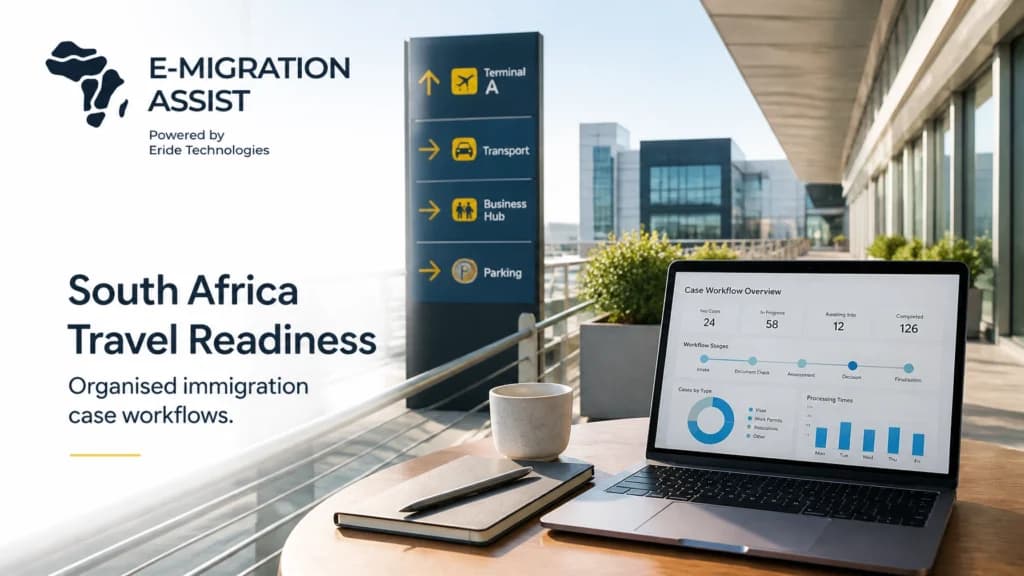
Hook caption: A boarding pass confirms that you can fly. It does not confirm that your South Africa entry plan is ready. Here are the last-mile checks to complete before you leave home.
The airport often feels like the moment everything begins.
You scan your passport. You check your gate. You join the queue. You wait for boarding.
But for international travel to South Africa, the airport is usually the final checkpoint in a process that started much earlier.
The real work happens before departure.
That means checking your permission to travel, reviewing passport validity, confirming supporting records, monitoring your application status and knowing who to contact if something changes.
A digital entry environment can make travel more efficient. It can also expose gaps faster.
A missing approval.
An expired passport.
A changed connection.
A booking that no longer matches your application.
A reference number nobody can find.
The solution is not more last-minute searching.
The solution is a structured pre-travel readiness process.
Important: South Africa visa requirements can vary according to your nationality, purpose of travel, length of stay, travel route and current immigration policy. Always confirm the latest requirements through the official South African government visa information and the relevant South African mission or authority.
Permission first. Plans second.
Before you confirm the finer details of your trip, confirm that your permission matches the reason you are travelling.
Are you visiting for tourism?
Are you travelling for business meetings?
Are you coming to study, work or relocate?
Are you transiting through South Africa?
Will you stay longer than a short visit?
These are not interchangeable purposes.
The correct route may involve a visa, a visa exemption or, for eligible travellers, the South Africa ETA. The official South African ETA portal explains that the ETA is a digital authorisation for eligible visa-required travellers visiting for tourism or visitor purposes. Visa-exempt travellers may also be able to use the ETA for more efficient processing.
The ETA is linked to the passport used in the application. It is not designed for employment in South Africa. The official portal also states that eligible applicants must land at O. R. Tambo International Airport, Cape Town International Airport or Lanseria International Airport.
That makes one principle clear:
Your travel permission and your actual journey must tell the same story.
: You apply for one purpose but plan activities associated with another.
: You receive an authorisation linked to one passport but travel with a replacement passport.
: You use an eligible airport assumption but change your route.
: You treat an ETA as permission for work or extended stays.
- Confirm the purpose of travel.
- Confirm the correct permission route.
- Confirm that your nationality, airport and itinerary align with the relevant process.
- Save the official approval or reference details before departure.
E-Migration Assist can help travellers and their advisers turn these questions into a visible readiness workflow. The platform does not make the immigration decision. It helps organise the information that must be checked before the decision becomes a boarding problem.
Passport validity is an operational check, not a formality
Many travellers check whether their passport is valid.
Fewer check how long it remains valid after they plan to leave South Africa. Fewer still check whether it has enough blank pages and whether the document is in usable condition.
Airline check-in teams may review passport and entry requirements before boarding. A problem identified at the airport is already expensive and difficult to solve.
For South Africa travel, official and consular guidance commonly refers to:
: Passport validity extending beyond the intended departure date.
: Sufficient blank visa pages for endorsements or stamps.
: A passport that is undamaged and readable.
: The same passport being used throughout the permission process and journey.
Do not wait until the day of travel to inspect the document.
- Check the passport number against every application and booking.
- Check the expiry date against the full travel period.
- Check blank pages, not just the cover and photograph page.
- Check whether a renewed passport changes any linked ETA, visa or booking information.
- Keep a secure copy of the identity page and relevant approvals.
This is where structure replaces anxiety.
A readiness checklist can show what has been checked, who checked it and what still needs attention. That matters to an individual traveller. It matters even more to a relocation company or agency managing several travellers on different departure dates.

Supporting records should be ready for the journey you are actually taking
A visa or ETA is not the only information that may matter at the border.
Your supporting records should be consistent with your itinerary and available if requested. Depending on your circumstances, these may include:
: Return or onward travel details.
: Accommodation confirmation or host information.
: Proof of funds.
: A letter explaining the purpose of the visit.
: Contact details for an employer, institution, host or relocation provider.
: A yellow fever certificate where applicable to your route.
: Documents connected to a longer-term visa or permit application.
The question is not simply, “Do I have the document?”
The better question is, “Can I find the right document quickly, and does it match my current plan?”
A hotel booking for the wrong city is not a useful readiness record.
A return ticket with different dates creates avoidable questions.
A letter with an old address can cause confusion.
A certificate saved in an inaccessible email account is not operationally ready.
- Match accommodation to the current itinerary.
- Match travel dates to the intended period of stay.
- Match contact details to people who can respond.
- Store important records in a secure, organised location.
- Give the traveller and authorised support contact access to the same current information.
This is not about carrying every document ever received.
It is about carrying the right evidence for the journey you are actually taking.
Itinerary changes can create a new checking task
Travel plans change.
A flight is moved.
A connection is cancelled.
A traveller adds a domestic leg.
A hotel changes.
A business meeting moves to another city.
A family member travels on a different date.
These changes may look logistical. They can also affect the information connected to a visa or ETA process.
The old way is familiar:
: A traveller updates an airline booking.
: An adviser receives a message in a crowded inbox.
: A travel agent keeps a spreadsheet.
: A relocation team relies on a WhatsApp conversation.
: Nobody can confirm which version is current.
The new way is controlled:
- Record the change against the relevant case.
- Identify which documents or confirmations are affected.
- Recheck the permission and itinerary alignment.
- Assign responsibility for the review.
- Log the outcome and the next action.
E-Migration Assist provides a central place for case information, requirements, documents, tracking and decision logging. For travellers, that means a clearer path from preparation to departure. For immigration professionals, attorneys, HR and global mobility teams, it means fewer disconnected updates and more control across active cases.
The purpose is simple: an itinerary change should trigger a check, not a scramble.
South Africa visa tracking should lead to a readiness decision
South Africa visa tracking is useful only when the status leads to a clear next step.
“Submitted” is not the same as “ready to travel.”
“Under review” is not the same as “approved.”
“Documents uploaded” is not the same as “documents accepted.”
“Approval received” is not the same as “passport and itinerary checked.”
If your application was submitted through a mission or external application centre, use the relevant official tracking route and keep the reference number secure. If you applied through the official ETA portal, monitor the online account associated with the application.
Then connect the status to an operational decision:
: What is the current status?
: What evidence confirms that status?
: Is any action outstanding?
: Who is responsible for the next check?
: When should the case be reviewed again?
: What happens if the status does not change before departure?
A case management system makes these questions visible.
E-Migration Assist supports structured workflows, secure document handling, status monitoring and decision records. It gives authorised users a shared view of what is complete, what is pending and what requires human review.
Technology should not create false certainty.
It should create reliable visibility.

Every traveller needs an escalation route
A good pre-travel plan includes a contact point for ordinary questions and an escalation route for urgent problems.
Before leaving home, identify:
- The traveller’s primary contact.
- The travel agency or relocation company contact.
- The immigration practitioner or professional adviser, where applicable.
- The employer, host or education provider contact.
- The relevant airline support channel.
- The official authority or mission contact for the specific issue.
Do not assume that the person who helped prepare the application will automatically know about a last-minute flight change.
Do not assume that an airline can resolve an immigration question.
Do not assume that a traveller can access an old email thread while standing at check-in.
Assign the route in advance.
For professional teams, this can be built into the case workflow. For individuals, it can be included in the final readiness review.
The goal is not to predict every possible problem. The goal is to avoid uncertainty about what happens next.
The final 24-hour review
The last review should be short, practical and based on the current trip.
Use this checklist:
: Permission confirmed for the intended purpose.
: ETA, visa or exemption position checked for the traveller’s nationality.
: Passport number and validity checked.
: Blank pages checked.
: Flight route and arrival airport confirmed.
: Accommodation and onward travel records current.
: Supporting records accessible.
: Application or South Africa visa tracking status reviewed.
: Contact points confirmed.
: Escalation route understood.
- One current itinerary.
- One clear status.
- One responsible contact.
- One documented next step.
That is what readiness looks like.
The airport is still important. It is where the final operational checks occur.
But confident travel starts earlier: when permission, documents, plans and contacts are brought into one structured process.
For individuals, travel agencies, relocation companies and professional advisers, E-Migration Assist provides the infrastructure to create that clarity before departure.
Start with an assessment. Build a controlled workflow. Check the details before they become an airport problem.
Less admin. More control. A more prepared journey.
#SouthAfricaVisaRequirements #SouthAfricaETA #SouthAfricaVisaTracking #SouthAfricaImmigration #TravelToSouthAfrica #GlobalMobility #ImmigrationTechnology #VisaApplication #TravelReadiness #E MigrationAssist
