


 Check Your Eligibility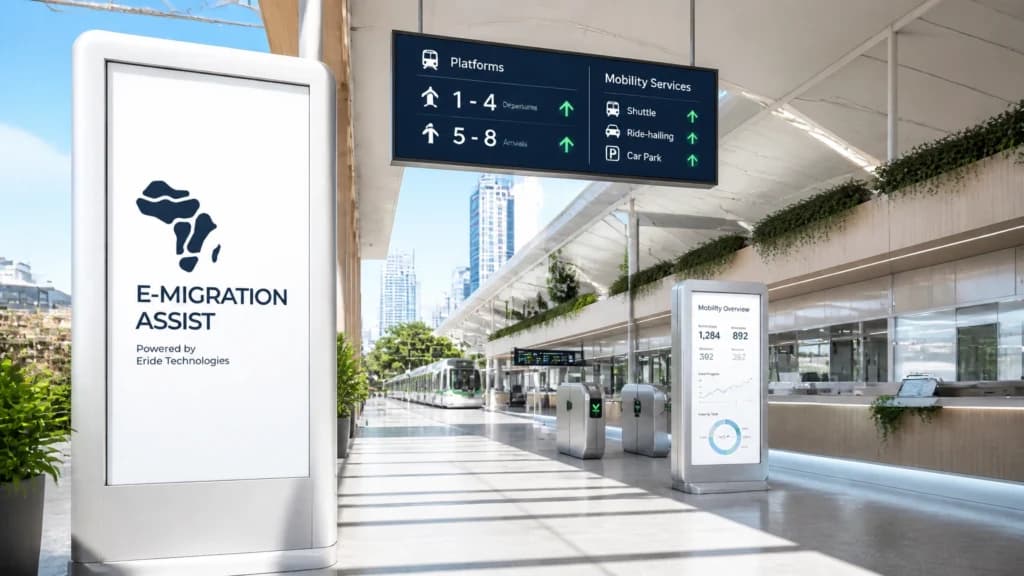
Caption: South Africa’s immigration future is becoming digital. But digital entry is only one part of the journey. The real advantage comes when every document, requirement, review and decision is connected: securely, clearly and responsibly. Read why connected case data will define the next era of global mobility.
A digital entry authorisation can make travel faster.
It cannot, by itself, make an immigration process organised.
That distinction matters.
South Africa is moving toward a more digital immigration environment. The Electronic Travel Authorisation, or ETA, is an important part of that transition. It introduces online pre-clearance, digital identity checks and stronger links between travel authorisation and movement records.
But mobility is more than the moment a traveller reaches the border.
It includes the planning before departure. The documents collected. The requirements reviewed. The decisions recorded. The status updates shared. The compliance obligations managed after arrival.
The future of mobility is not simply digital entry.
It is connected case data.
The digital entry conversation is only the beginning
The South African ETA is designed to support digital pre-clearance for eligible short-term travellers.
At the time of drafting, official ETA guidance identifies ordinary passport holders from:
- Mainland China
- India
- Indonesia
- Mexico
The current scope is focused on short-term tourism and business travel. It is not a replacement for a work visa, study visa, residence visa or another long-term immigration route.
Current operational details also require careful checking. Official guidance has identified major airports such as OR Tambo International Airport, Cape Town International Airport and Lanseria International Airport, while government communications have described a phased expansion to other airports and key land ports.
This is the important point: the ETA is live, but its scope and operational coverage must be checked before every journey.
Travellers should use the official South African ETA portal and review the official ETA frequently asked questions. Do not rely on an old social media post, a forwarded email or a spreadsheet last updated several months ago.
: Assuming that every nationality is already eligible
: Treating an ETA as permission to work or study
: Confusing an approval to travel with a long-term immigration status
: Ignoring the port of entry connected to the authorisation
: Losing access to the documents used during the application
- Check the current ETA scope
- Confirm the purpose and length of the visit
- Verify the correct port of entry
- Keep a clear record of the application
- Store supporting documents securely
The result is not just a smoother journey. It is a more controlled journey.
What “connected case data” really means
Connected case data does not mean collecting every possible piece of information.
It means connecting the information that is necessary to manage a case properly.
For an individual traveller, this may include:
- Passport details
- Travel purpose
- Planned arrival and departure dates
- Proof of accommodation
- Financial evidence
- Supporting correspondence
- ETA or visa records
- Submission history
- Requests for additional information
- Final decisions and conditions
For a professional firm or corporate mobility team, it may also include:
- Client or employee profiles
- Visa category
- Case owner
- Document status
- Review history
- Deadlines
- Appointment requirements
- Communication records
- Compliance milestones
- Decision logs
The value is not in the volume of data.
The value is in the structure.
When these records are disconnected, the process becomes dependent on memory. A document sits in an inbox. A deadline is written in a notebook. A status update is buried in a WhatsApp conversation. A spreadsheet shows one version of the case while a colleague has a newer version saved elsewhere.
That is the old way.
: Manual folders
: Scattered emails
: Unclear ownership
: Duplicate data entry
: Repeated requests for the same document
: No reliable audit trail
The new way is a controlled workflow.
- One case record
- One document structure
- One requirements checklist
- One review history
- One status view
- One source of operational truth
That is how connected data creates clarity.

ETA data and case data are related: but they are not the same
This distinction is critical.
The Department of Home Affairs’ ETA programme is part of government’s digital immigration and border-management architecture. Public government communications describe the use of online applications, biometric verification, machine-learning-supported risk analysis and connections to movement-control systems such as the upgraded Electronic Movement Control System.
The wider policy direction is ambitious. The Cabinet-approved White Paper on Citizenship, Immigration and Refugee Policy describes a long-term objective for the ETA to become a single point of application, adjudication and communication for all visa categories.
But that is a future integration plan.
It should not be presented as the current reality for every visa type.
At present, the ETA’s practical use remains narrower than the full digital immigration vision. Work visas, study visas, family-related applications and other complex immigration matters continue to require the appropriate route and supporting process.
This is where many discussions become confusing. A future roadmap is treated as if it is already fully operational. A digital travel authorisation is described as if it replaces every visa category. A border record is confused with a complete case-management record.
They are different layers.
Government digital systems may manage authorisations, identity verification and movement control.
Case-management infrastructure helps travellers, practitioners and mobility teams prepare, review, track and retain the information required to manage their own immigration cases.
The two environments may become more connected over time. They should not be assumed to be fully integrated today.
Why professional firms need connected case data
Immigration practitioners, attorneys, agents and corporate mobility teams manage more than forms.
They manage dependencies.
One missing document can delay a complete application. One incorrect date can create inconsistency across multiple records. One undocumented client request can make it difficult to explain what happened later.
Growth makes this harder.
A professional firm handling five cases may still rely on email and spreadsheets. A firm handling 50 or 500 cases needs a system.
: No consistent process between practitioners
: No clear view of which cases need attention
: No standard for document review
: No dependable decision history
: No easy way to identify bottlenecks
- Structured workflows by visa type
- Documents mapped to the right stage
- Human-reviewed guidance
- Real-time case tracking
- Archived decisions and activity logs
- A repeatable operating model
Connected case data allows firms to standardise without becoming impersonal. It gives professionals more time to focus on judgement, client communication and strategy.
E-Migration Assist is not an immigration consultancy and does not replace legal or professional advice. It is supportive, AI-powered infrastructure for firms that need a more reliable way to manage South African immigration workflows.
Explore the professional case-management platform to see how structured workflows can replace spreadsheet-driven administration.
Why individual travellers need it too
The same principle applies to individuals.
A traveller may only have one application. That does not make the process simple.
The case may involve multiple documents, changing requirements, time-sensitive travel arrangements and uncertainty about the correct visa category. The emotional cost of disorganisation can be high.
: “Which document am I still missing?”
: “Did I upload the correct version?”
: “Where is the latest request?”
: “What happens next?”
: “Can I still travel for this purpose?”
A connected process answers these questions through structure.
- A checklist tailored to the application
- Guided document uploads
- Clear stages from preparation to submission
- A record of what has been reviewed
- A central place for case information
- More confidence before travel
This does not guarantee an approval. No responsible platform can promise that.
It does create a clearer, more complete and more manageable application process.
See the traveller workflow for a practical view of how guided immigration infrastructure can reduce confusion.
Privacy must be designed into the system
Connected data is valuable because it is sensitive.
Immigration cases can contain passport details, identity information, financial records, employment evidence, family documents and private correspondence. More connectivity without stronger controls creates more risk.
The answer is not to return to paper.
The answer is to build privacy into the operating model.
A privacy-conscious case system should support:
- Role-based access
- Secure document storage
- Controlled user permissions
- Clear activity records
- Appropriate retention policies
- Lawful processing practices
- No sale of personal information
- Transparent handling of service providers
E-Migration Assist’s Privacy Policy explains its approach to personal information, immigration case data, access controls, secure cloud infrastructure and POPIA-related responsibilities.
Technology should make information easier to manage: not easier to expose.
That requires discipline from both the platform and the user. Clients should upload documents through secure channels. Firms should assign appropriate permissions. Everyone involved should understand what data is being collected, why it is needed and how it will be retained.
Privacy is not a decorative feature.
It is part of case quality.

The operational question for 2026 and beyond
The question is no longer whether immigration will become more digital.
It is how prepared each participant will be for the change.
The ETA introduces a more connected entry environment. Future plans point toward wider digital processing across visa categories. The transition will create opportunities for faster verification, better visibility and more consistent records.
It will also expose weak internal processes.
A firm that still depends on inbox searches will struggle when digital records multiply. A traveller who stores every document in separate chat threads will struggle when a case requires a precise history. A mobility team without ownership rules will struggle to track several employees across different immigration routes.
Digital entry is the visible part of the transformation.
Connected case data is the operational foundation underneath it.
The future-ready approach is clear:
: Do not confuse digital access with complete case control.
: Do not assume a future integration is already fully available.
: Do not treat sensitive records as ordinary attachments.
: Do not build a mobility process around memory and scattered messages.
- Build a structured record.
- Use the correct workflow.
- Review information before submission.
- Track every important change.
- Protect personal data at every stage.
- Keep human judgement at the centre.
That is how mobility becomes scalable, accurate and ready for change.
Build more control into your immigration workflow
South Africa’s digital immigration journey is developing in stages.
The ETA is one stage. Connected case data is the broader opportunity.
For travellers, it means less uncertainty and a clearer path. For professional firms, it means less administration and more operational control. For corporate mobility teams, it means a stronger foundation for managing people, documents, deadlines and compliance responsibilities across multiple cases.
E-Migration Assist provides supportive, AI-powered infrastructure for South African immigration case management. It helps organise workflows, documents, requirements, tracking and decision records while keeping human-reviewed guidance central to the process.
The goal is simple:
Less admin. More control. Better structure.
Start your assessment and see how a connected, privacy-conscious workflow can support your next immigration case.
#SouthAfricaImmigration #SouthAfricaETA #ElectronicTravelAuthorisation #DigitalImmigration #VisaApplication #ImmigrationCaseManagement #GlobalMobility #CorporateMobility #SecureDocumentManagement #POPIA #ImmigrationTechnology #LegalTech #SouthAfricaVisa #TravelToSouthAfrica #EMigrationAssist