


 Check Your Eligibility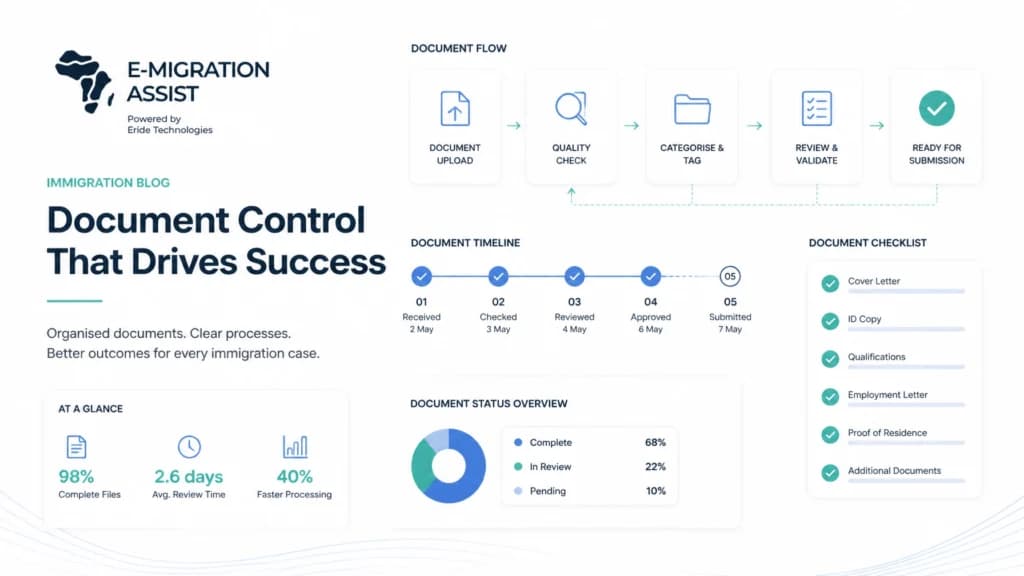
Hook caption: Your visa file can look complete and still contain a hidden problem. One outdated passport copy, inconsistent name, missing translation or forgotten email attachment can create uncertainty when your application needs clarity.
Applying for a South Africa visa or permit is often described as a checklist exercise.
In practice, the checklist is only the beginning.
The real problem is document quality.
Not whether you have uploaded something. Whether you have uploaded the correct version, with consistent information, within the required validity period, in the correct format and with the supporting evidence needed to explain any differences.
That is where many applications become confusing.
The old way is familiar:
: A passport copy in one email.
: A bank statement in another.
: A translated birth certificate saved on a laptop.
: An older version of the application form attached to a WhatsApp message.
: A name-change document buried in a shared folder.
: A professional trying to work out which file is final.
The result is administrative risk.
The new way is structured:
- One central case file.
- One clear document requirement.
- One identifiable current version.
- One recorded review history.
- One workflow showing what is complete, what is missing and what needs attention.
That difference can create more clarity before submission.
The document problem is rarely one dramatic mistake
Most document issues are small.
They do not always look serious when viewed separately. But immigration applications are assessed as connected files. A small inconsistency in one document can create questions about another.
Consider a typical file.
The passport says Amelia Rose Dlamini.
The birth certificate says Amelia R. Dlamini.
The marriage certificate says Amelia Rose Nkosi.
The bank statement uses A. R. Nkosi.
None of these names may be fraudulent or incorrect. They may reflect different issuing systems, a marriage, a middle name being omitted or a standard abbreviation.
But without a clear explanation and supporting documents, the file becomes harder to follow.
The same problem appears with document versions.
A client sends a bank statement dated 5 June. Two weeks later, they send another dated 20 June. The file contains both. Neither is marked as superseded. The reviewer must now decide which document should be used.
That is not a minor inconvenience.
It is a control problem.
1. Version confusion: “final” may not mean final
Email makes document sharing easy. It also makes document control difficult.
Files are commonly saved as:
passport_scan.pdfpassport_scan_new.pdfpassport_scan_latest.pdfpassport_scan_final.pdfpassport_scan_final_2.pdf
Which one should be used?
A file name is not a document-management system. It does not show:
- When the document was issued.
- When it was uploaded.
- Whether it replaced another version.
- Whether it was reviewed.
- Whether a required page is missing.
- Whether the file is still valid for the intended application.
This becomes particularly important when working with bank statements, proof of accommodation, letters of invitation, employment letters and certified copies.
The solution: create a document history
A structured workflow should make every document answer five basic questions:
- What requirement does this document satisfy?
- Who uploaded it?
- When was it uploaded?
- Is it the current version?
- Has it been reviewed?
This does not replace professional judgment. It supports it.
For individuals, it creates a clear view of what still needs attention. For immigration practitioners, attorneys and global mobility teams, it reduces the time spent searching through attachments.
- Clear version control.
- Clear ownership.
- Clear status.
- Clear next action.
The outcome is less admin and more control.

2. Inconsistent names: the identity trail becomes unclear
Names can differ across passports, birth certificates, marriage certificates, academic records and police clearances.
Common examples include:
: Maiden and married surnames.
: Missing middle names.
: Different name order.
: Spelling variations.
: Transliteration differences.
: Typographical errors on older documents.
: Initials used on financial records.
: Names changed after adoption or an official name-change process.
The important point is not to assume that every difference will be understood automatically.
A South Africa visa application should generally use the applicant’s current passport details consistently. Where supporting documents show a different name, the application may need evidence connecting the names.
That evidence could include a marriage certificate, divorce order, official name-change document or other relevant record. Depending on the situation and the applicable checklist, an explanation may also be needed.
This article is not legal advice. Requirements vary by visa category, applicant circumstances and the office or mission handling the application. Always review the relevant official checklist.
The South African Government visa guidance links to visa requirements and visa categories. A mission-specific checklist may also provide additional instructions. For example, the South African High Commission in Canberra visa guidance states that supporting documentation may need to be original or certified copies and, where applicable, translated into English by a sworn translator.
The solution: build an identity consistency check
Before submission, compare the applicant’s name across every key document.
Record:
- The exact name in the current passport.
- The name shown on the birth certificate.
- Any previous name.
- The document that explains the change or variation.
- Whether an English translation is required.
- Whether a formal written explanation is needed.
The goal is not to alter official documents.
The goal is to make the identity trail understandable.
- One primary identity reference.
- One list of known variations.
- One evidence path for each variation.
- One human review before submission.
That is how an unclear file becomes a structured file.
3. Expired documents: the file looks complete, but the evidence is old
An expired document can be easy to overlook.
The applicant may have uploaded a passport copy months ago. The file may also contain an old visa, previous permit or outdated proof of residence. The document is still readable. It may even be relevant historically.
But it may not satisfy the current requirement.
South African visa requirements commonly focus on a valid travel document. The exact validity period and blank-page requirements depend on the applicable visa category and checklist. The Canberra guidance, for example, refers to a machine-readable passport valid for a specified period after the intended visit and requiring blank pages.
The key question is simple:
Is this document still valid for this application?
A file should distinguish between:
- Current documents required for submission.
- Historical documents included for context.
- Expired documents that should not be used as current evidence.
- Documents that must be replaced before the case can proceed.
This distinction matters for passports, police clearances, bank statements, medical reports, photographs, proof of accommodation and certification dates.
The solution: track dates, not just uploads
A document-quality review should record:
- Issue date.
- Expiry date.
- Certification date.
- Translation date.
- Required renewal date.
- Date checked by the reviewer.
A secure case-management platform can help surface these dates instead of leaving them buried inside attachments.
That gives the applicant or professional a forward-looking view.
Not just: “Has the document been uploaded?”
But: “Will the document still be usable when the application is submitted?”
That is a much stronger control.

4. Missing translations: the document exists, but the reviewer cannot use it
A supporting document may be genuine and complete in its original language.
That does not necessarily mean it is ready for a South Africa visa application.
Where a checklist requires documents to be submitted in English, an applicant may need to provide the original document or certified copy together with an appropriate translation. The relevant authority or mission may specify what it accepts as a sworn or certified translation.
This issue often affects:
- Birth certificates.
- Marriage certificates.
- Divorce orders.
- Police clearances.
- Bank letters.
- Academic records.
- Employment documents.
- Name-change documents.
The common mistake is to upload the original document and assume the translation can follow later.
That creates an incomplete requirement.
The solution: pair documents before review
Treat the original and translation as one document set.
For each non-English document, confirm:
- Original or accepted certified copy included.
- Translation attached.
- Translator credentials or certification included where required.
- Names and dates match across both versions.
- The translation is legible.
- The document is mapped to the correct requirement.
This is particularly valuable when several family members or dependants are included in one application.
A structured workflow prevents the original from being marked complete while the required translation remains forgotten in an email.
5. Scattered email attachments: the hidden source of uncertainty
Email is useful for communication.
It is not designed to manage a complex immigration case.
Attachments can be:
- Sent to the wrong person.
- Downloaded without context.
- Duplicated.
- Missed in a long thread.
- Stored on a personal device.
- Forwarded without access controls.
- Separated from the requirement they were meant to satisfy.
Immigration documents also contain sensitive personal information. Passports, birth certificates, bank statements and police clearances should not be treated like ordinary attachments.
This is where POPIA immigration documents become an important consideration.
E-Migration Assist’s Privacy Policy and POPIA Notice explain the platform’s approach to personal information, including secure cloud infrastructure, role-based access, appropriate security measures and the responsible handling of immigration and case data.
POPIA does not remove visa document requirements. It governs how personal information should be processed and protected. Applicants and professional service providers should still confirm the privacy practices of every system used to collect, store or share sensitive documents.
The solution: use a privacy-first document space
A central portal creates a controlled path:
- The applicant uploads the document.
- The document is linked to a specific case requirement.
- The system records the activity.
- A human reviewer checks the file.
- The applicant receives a clear status or action.
- The current version remains visible.
This is more reliable than asking, “Did you send that attachment?”
It also creates a better client experience.
The applicant feels confident. The professional sees the full picture. The case has a record.
A practical document-quality checklist
Before treating a document as ready, check the following:
Identity
- Does the name match the current passport?
- Are all spelling, surname or name-order differences explained?
- Is supporting evidence included for a formal name change?
- Are dependants’ documents matched to the correct person?
Validity
- Is the passport valid for the applicable requirement?
- Are there enough blank pages where required?
- Are bank statements recent enough?
- Are certified copies still within the required date range?
- Are photographs current?
Completeness
- Are all pages included?
- Is the document readable from beginning to end?
- Are signatures and dates present where required?
- Are old versions clearly marked as superseded?
- Are supporting documents attached to the correct requirement?
Language
- Is the document in English where required?
- If not, is an accepted translation included?
- Do the translation and original show consistent names, dates and reference numbers?
Security and control
- Was the document shared through a secure channel?
- Is access limited to the people managing the case?
- Is the file stored against the correct applicant and visa type?
- Is there a record of review?
- Is the next action visible?
If any answer is unclear, the document is not ready to be treated as complete.
From document collection to document control
The hidden immigration document problem is not simply missing paperwork.
It is the absence of structure around the paperwork.
The old way depends on memory, inbox searches, spreadsheets and repeated follow-ups.
The new way uses a powered foundation:
- Structured workflows by visa type.
- Secure document handling.
- Requirements checklists.
- Human-reviewed guidance.
- Version visibility.
- Status tracking and decision logging.
E-Migration Assist is an online AI-powered case-management system for individuals and professional service providers managing South African immigration matters. It is not an immigration consultancy and does not replace legal or regulated professional advice.
It provides the infrastructure to organise the process, reduce avoidable uncertainty and support better document control.
For travellers, that means a clearer path through South Africa visa requirements.
For immigration professionals, law firms and corporate mobility teams, that means fewer scattered attachments, less repetitive administration and a more scalable case workflow.
Ready to bring clarity to your immigration document process? Start your assessment with E-Migration Assist.
Less admin. More control. A structured file from the start.
#SouthAfricaVisa #SouthAfricaVisaRequirements #ImmigrationDocuments #POPIA #POPIAImmigrationDocuments #VisaApplication #ImmigrationTechnology #CaseManagement #GlobalMobility #LegalTech #DocumentManagement #ImmigrationProfessionals