


 Check Your Eligibility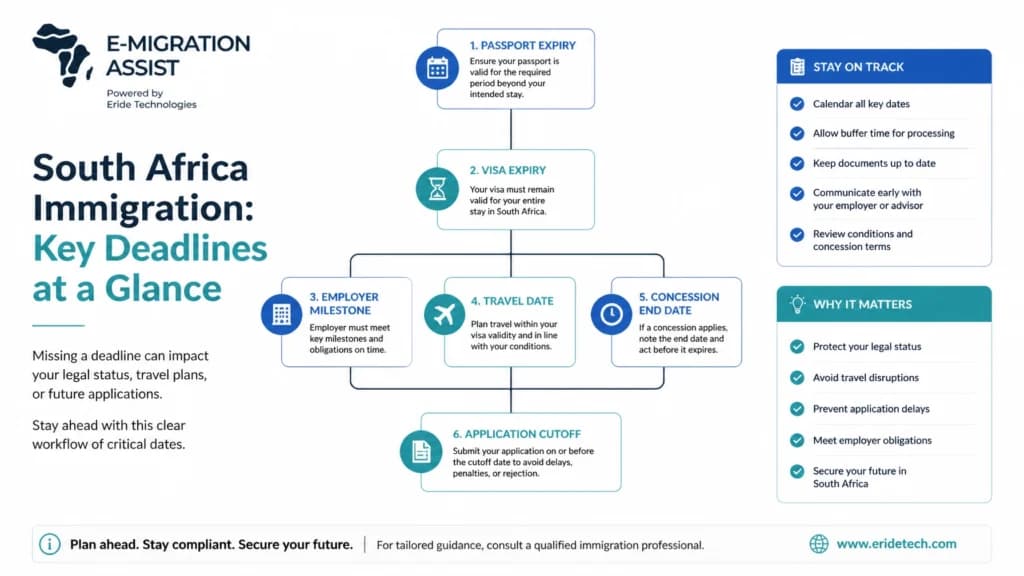
Hook caption: Your visa may expire on one date. Your passport may control another. Your employer may need action before both. Here is how to build a deadline system that keeps your South African immigration process clear and controlled.
A visa deadline rarely exists on its own.
One person can be tracking:
: Passport expiry
: Visa or permitted-stay expiry
: Employer contract or compliance milestone
: Concession end date
: Planned travel date
: Application or renewal cut-off
That is how a manageable process becomes overwhelming.
A date is saved in an email. Another is written in a spreadsheet. A third is mentioned in a WhatsApp message. Nobody is completely sure which deadline matters most.
The solution is not another calendar reminder.
The solution is a deadline hierarchy.
For individuals, that hierarchy creates confidence. For immigration practitioners, attorneys and corporate mobility teams, it creates a repeatable workflow across multiple cases.
Why one immigration case can have several deadlines
South African immigration planning involves more than the date printed on a visa label.
A traveller may have a visa that appears valid until 30 November. However, their passport may expire on 15 October. Their employment contract may require proof of continued employment in September. Their flight may be booked for 20 October. A temporary concession, if officially applicable, may end on another date.
These dates do not automatically carry the same legal effect.
They also do not automatically extend one another.
A planned flight does not extend a visa. A pending application does not necessarily make international travel safe. A concession does not apply simply because it was mentioned online. An employer milestone does not replace an immigration requirement.
That is why visa tracking in South Africa must be built around relationships between dates, not isolated reminders.
The first deadline: the passport
Start with the passport.
South African immigration requirements generally connect passport validity to both visa validity and intended departure. The Immigration Regulations require a passport to remain valid for at least 30 days after the foreign national’s intended date of departure. Official guidance also states that a visa should not extend beyond the passport’s validity.
This creates a basic control:
If the passport expires first, it may become the controlling date for immigration planning.
For example:
: Visa expiry shown: 30 November
: Passport expiry: 15 October
: Intended departure: 20 October
The printed visa date does not resolve this conflict. The passport date must be investigated first. The intended departure date may also fail the 30-day passport validity requirement.
Do not assume that renewing the passport automatically transfers or preserves the visa. According to published immigration guidance, a visa that extends beyond the passport expiry may lapse when the passport expires and may not simply transfer to a new passport.
Practical action: record the passport expiry before recording any visa deadline. Then calculate whether the passport has sufficient validity for the planned departure and any proposed visa period.
For current government information, consult the South African Government visa guidance and the Border Management Authority travel information.
The second deadline: visa expiry or permitted stay
The next date is the visa or permitted-stay deadline.
These are not always the same thing.
A visa may authorise entry or establish a period of validity. The admission stamp, visa conditions or other immigration record may determine how long the person may remain for that particular stay.
For short-term travel, a visitor’s visa is generally issued for tourism or business and may be valid for up to 90 days, subject to the applicable conditions. The actual permitted stay must be checked against the document and entry record.
The key question is not:
“What date do I remember?”
The key questions are:
: What is the visa type?
: What does the visa label say?
: What does the admission stamp say?
: What conditions apply?
: Is the passport still valid for the planned departure?
: Has any written approval changed the position?
A case management system should store these records together. A single expiry field is not enough.
For professional service providers, this means each case needs a clear distinction between:
- Visa validity
- Permitted stay
- Passport validity
- Application status
- Travel permission or restrictions
That structure reduces the risk of treating a general date as a confirmed legal outcome.
The third deadline: employer milestones
Employment creates its own timetable.
A work visa may be linked to an employment contract, job description, employer information or proof that the person remains employed. Some work visa obligations require evidence of continued employment after issuance and at later intervals.
That means an employee may face an employer milestone before the visa expiry date.
For example:
: Visa expiry: December
: Annual proof-of-employment requirement: September
: Contract renewal decision: August
: Passport expiry: October
Waiting until December may be too late for the operational work required in August or September.
The employer milestone does not necessarily change the visa expiry date. It may, however, trigger a document, review or escalation requirement.
The correct approach is to create a separate task for each dependency:
- Confirm the current employment contract
- Confirm the job description and conditions
- Confirm who must provide supporting evidence
- Record the internal review date
- Escalate missing information before the deadline
For corporate mobility teams and immigration firms, this is where manual systems become unreliable. The information may be divided between human resources, the employee, an external adviser and a case file.
A central workflow gives every authorised stakeholder a clear view of the next action.
Less chasing. More control.

Concession dates need separate treatment
A concession is not an ordinary expiry date.
A concession may be introduced for a defined group, period or circumstance. It may be subject to conditions. It may not apply to every visa type or every person. It may also be withdrawn, replaced or allowed to expire.
The safe rule is simple:
Treat a concession as valid only when you have confirmed the official source, scope, conditions and end date.
Do not use a historic concession as a planning assumption for a current case. Do not treat an online post, forwarded message or informal explanation as proof that a concession applies.
Create a concession record containing:
: The official publication or source
: The date it starts
: The date it ends
: The affected visa or applicant category
: Any conditions
: The person responsible for verification
A concession can affect risk assessment. It should not erase the underlying deadlines from the case file.
If the concession ends on 30 September, that date belongs in the system even if the visa label shows 31 October. The case must then be reviewed before 30 September to confirm what status applies after the concession.
Travel dates are operational deadlines
Travel dates are important. They are not always immigration deadlines.
A flight booked for 20 October creates a planning requirement. It does not guarantee that the person may enter, remain in or leave South Africa on that date.
Travel must be checked against the controlling immigration dates:
: Passport validity
: Visa or permitted stay
: Entry conditions
: Pending applications
: Exit implications
: Any concession or written approval
This is especially important where an extension or renewal application is pending. A person should not assume that an application receipt makes international travel risk-free. Departure can be assessed against the records and documents available at the border.
The correct response is not panic. It is escalation.
Before travel, confirm the position with the relevant qualified immigration professional or official authority. E-Migration Assist provides infrastructure for organising the case, documents and decision log. It does not make legal or immigration decisions.
A simple deadline hierarchy
Use this order when several dates appear to conflict.
1. Status-controlling dates
These are the dates that may determine whether a person has valid status:
- Visa or permitted-stay expiry
- Passport expiry where it affects visa validity
- Official concession end date, if confirmed and applicable
Identify the earliest controlling date. Mark it as high priority.
2. Application and compliance dates
These are the dates by which preparation or submission may need to happen:
- Extension or renewal submission cut-off
- Employer proof-of-employment milestone
- Contract or assignment review
- Document validity dates
For many temporary residence extensions, official guidance refers to applying at least 60 days before the current visa expires. Treat this as a planning control, then verify the requirements that apply to the specific visa category and case.
3. Operational dates
These are the dates that affect logistics:
- Planned arrival
- Planned departure
- Relocation date
- Project start
- Accommodation or onboarding date
Operational dates must fit around the status-controlling dates. They do not replace them.

What to do when deadlines conflict
Use a three-step escalation approach.
Step one: verify
Collect the original documents.
Check the passport biodata page, visa label, entry stamp, employment documents, application receipt and any official concession notice. Do not rely on memory or a calendar entry without a source.
Step two: calculate
Map every date in one place.
Record:
: The date
: What it relates to
: The source document
: The required action
: The owner
: The escalation level
Then identify the earliest date that could affect lawful status, compliance or travel.
Step three: escalate
If the dates conflict, escalate before the earliest high-risk deadline.
A professional firm may need to request updated documents from the client or employer. A corporate mobility team may need to pause travel bookings. An individual may need to obtain qualified immigration guidance or official confirmation.
Do not wait for the final day to discover that the passport, visa and travel plans do not align.
From deadline anxiety to deadline control
The old way is familiar:
: Dates spread across emails
: Documents stored in unrelated folders
: Manual spreadsheet updates
: Unclear ownership
: Last-minute questions
: No reliable decision history
The structured way is different:
- One case record
- One document source
- One deadline hierarchy
- One task owner
- One escalation path
- One decision log
E-Migration Assist is built as a technology foundation for this work. Individuals can follow a structured immigration process. Professional service providers can manage cases, documents, workflows and client collaboration in one system.
The platform supports human-reviewed guidance and organised case management. It does not provide legal or immigration advice, guarantee an approval or replace a qualified professional.
The result is practical:
Less admin. More clarity. More control.
If your passport, visa, employer milestones and travel plans are starting to compete with one another, build a structured case before the dates become urgent.
Check your eligibility and start a structured assessment with E-Migration Assist.
Sources and further reading
- South African Government: Apply for a visa
- South African Government: Immigration Regulations
- Border Management Authority: Entering and leaving South Africa
- E-Migration Assist for travellers
- E-Migration Assist for professionals
- E-Migration Assist compliance and disclaimers
SEO keywords: visa tracking South Africa, South Africa visa expiry, passport validity South Africa, South African visa renewal, work visa compliance South Africa, immigration deadline tracking, visa extension South Africa, employer-sponsored visa South Africa, South Africa immigration case management, global mobility compliance
Hashtags: #SouthAfricaVisa #VisaTracking #ImmigrationCompliance #GlobalMobility #WorkVisa #VisaRenewal #ImmigrationTechnology #CaseManagement #E migrationAssist #SouthAfricaImmigration