


 Check Your Eligibility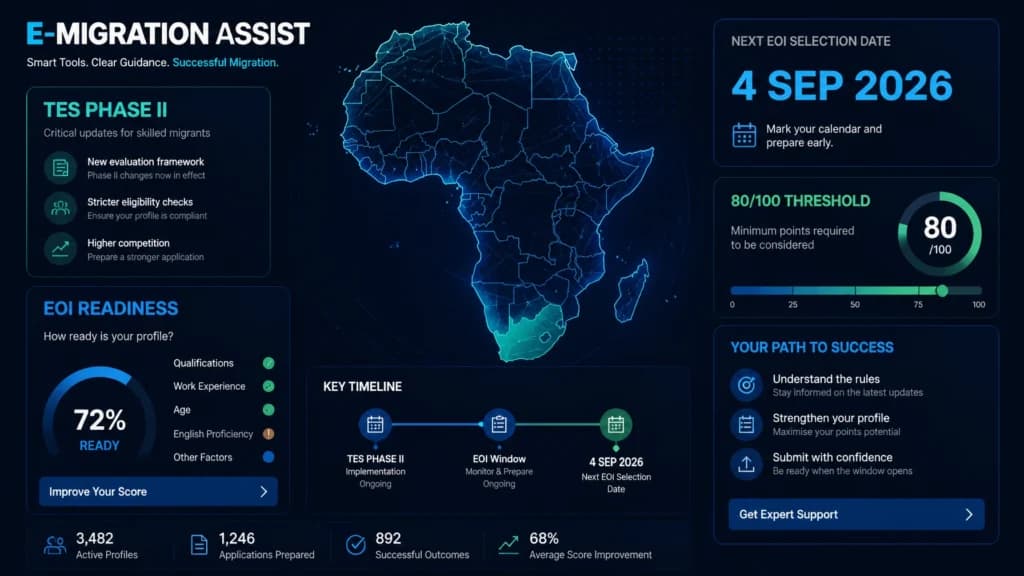
Hook caption:
The Trusted Employer Scheme deadline is 4 September. A strong Expression of Interest is not built in the final hour. It is built from one clear pathway, verified evidence, assigned owners and a consistent submission pack. Is your employer ready?
The South Africa Trusted Employer Scheme Phase II deadline is approaching.
Expressions of interest opened on 20 July 2026. They close on 4 September 2026.
That gives employers a defined window to decide, prepare and submit. It does not give them room for disorganised evidence, unclear ownership or contradictory information.
The question is not simply:
“Can we complete the form?”
The better question is:
“Can we show, in a clear and consistent way, why our organisation fits the pathway we have selected?”
This guide sets out a practical readiness system for employers, immigration professionals, HR teams and global mobility managers preparing a TES Phase II Expression of Interest.
This is general information, not legal advice. Requirements and official processes may change. Employers should review the official notice and work with their qualified immigration professionals where appropriate.
What has changed with TES Phase II?
The Department of Home Affairs has expanded the Trusted Employer Scheme to include:
- Infrastructure projects.
- Companies with an existing or intended Regional or Global Head Office in South Africa.
- Synthetic Financial Centres in the South African financial sector.
- Established South African-based corporate operations.
The official invitation states that TES is intended to support the attraction of skills and the processing of applications for senior executives, technical personnel, corporate employees and investors.
It is not intended for the employment of unskilled and low-wage labour.
The announcement was issued under Dr. Leon Schreiber, MP, Minister of Home Affairs. The department’s official communication describes TES Phase II as part of a broader digital transformation programme.
However, the opportunity still requires discipline.
: TES membership is not automatic.
: A minimum score of 80 out of 100 is required.
: Employers must select only one pathway.
: Selecting more than one pathway may result in disqualification.
: The Department of Home Affairs retains the right to grant or refuse membership.
: Approved companies should be willing to enter into a Memorandum of Agreement.
The official process also states that outcomes are expected within 30 working days after the 4 September closing date. That is an expected assessment period, not a promise of approval or an immediate outcome.
Step 1: Choose one pathway before collecting documents
A common mistake is to start gathering every document available before deciding which scorecard applies.
That creates noise. It also makes it harder to see whether the evidence supports the selected route.
Start with the pathway.

Pathway 1: South African-based operations
This pathway focuses on established corporate operations in South Africa.
The scorecard considers:
- Pledges or proven investment.
- Employment.
- Economic sector.
- Skills development.
The available score is 100 points. The employer needs at least 80 points for consideration.
Your team should ask:
- What investment can we prove?
- How many employees do we have?
- What percentage are South African citizens or permanent residents?
- Does our sector fall within the stated priority sectors?
- What active skills transfer, bursary or graduate development programme can we evidence?
Pathway 2: Regional or Global Head Office, including infrastructure
This pathway may be relevant to companies with an existing or intended Regional or Global Head Office in South Africa. The gazette also includes infrastructure-related criteria.
The scorecard considers factors such as:
- Local presence.
- Financial contribution.
- Employment.
- Economic sector.
This pathway requires careful evidence planning. A statement that the organisation intends to establish an office is not the same as a documented commitment supported by the required information.
Pathway 3: Synthetic Financial Centres
This is a specialised route for qualifying entities in the South African financial sector.
The scorecard considers:
- South African Reserve Bank exchange-control authorisation or the applicable extended framework.
- Recognised regulatory standing.
- Market infrastructure commitment.
- Synthetic Financial Centre Visa Facilitation Office certification.
- Skills transfer commitment.
This pathway may involve evidence from financial regulators, market infrastructure bodies and specialist compliance teams. It should not be selected simply because the organisation operates in financial services.
Choose the pathway that your evidence supports: not the pathway that sounds most attractive.
- One pathway.
- One scorecard.
- One evidence map.
- One accountable submission owner.
The result is less admin and more control.
Step 2: Build an evidence matrix
A score is only as strong as the evidence behind it.
Create a simple evidence matrix before drafting the final Expression of Interest. For every scoring factor, record:
- The requirement.
- The document or data source.
- The document owner.
- The date it was issued.
- The date it was checked.
- Any gaps.
- The person responsible for resolving the gap.
- The final status.
For example:
| Scoring factor | Evidence example | Owner |
|---|---|---|
| Investment | Audited records, investment confirmations or qualifying pledges | Finance |
| Employment | Workforce report and citizenship or permanent-residence data | HR |
| Economic sector | Relevant sector confirmation or supporting business documentation | Corporate affairs |
| Skills development | Skills transfer, bursary or graduate programme evidence | HR or ESG |
| Local presence | Registration, structure or office establishment documents | Legal or company secretary |
The exact supporting documents must be checked against the official TES Phase II application form and notice.
Do not rely on a spreadsheet stored in one person’s inbox.
: A document is uploaded but no one knows whether it is final.
: Two departments provide different employee numbers.
: A certificate has expired.
: A draft financial figure is used as if it were verified.
: A narrative claims skills development, but no programme evidence is attached.
A central evidence register makes these issues visible early.
Step 3: Assign owners, not just tasks
“HR to provide documents” is not an owner.
A useful owner has:
- A name.
- A responsibility.
- A due date.
- Access to the relevant source records.
- Authority to confirm whether the evidence is accurate.
For a TES submission, ownership may need to be divided across:
- Executive leadership.
- Human resources.
- Finance.
- Legal and compliance.
- Tax.
- Operations.
- Corporate affairs.
- Immigration professionals.
- External auditors or regulatory contacts, where required.
The immigration professional can help interpret requirements and prepare the submission. The employer remains responsible for providing accurate organisational information.
That distinction matters.
E-Migration Assist does not replace legal, immigration or regulatory advice. It provides supportive case-management infrastructure so the employer and its immigration professionals can coordinate the work in one structured environment.
- Assign the task.
- Assign the owner.
- Assign the due date.
- Record the review.
- Keep the decision history.
That is how a deadline becomes a workflow instead of a crisis.
Step 4: Check consistency across the submission
A strong Expression of Interest should tell one coherent story.
Compare the information in the:
- Application form.
- Scorecard responses.
- Supporting documents.
- Company profile.
- Financial evidence.
- Workforce data.
- Skills development narrative.
- Corporate structure documents.
Look for differences in:
- Registered company names.
- Trading names.
- Company numbers.
- Headcount.
- South African citizen and permanent resident percentages.
- Tax figures.
- Investment amounts.
- Office locations.
- Dates.
- Sector descriptions.
- Future commitments.
Inconsistency does not always mean the underlying information is wrong. It does mean the reviewer may need to stop and investigate.
That creates avoidable risk.
A final consistency review should be separate from the person who first collected the information. Fresh review matters. So does decision logging.
If the employer decides that one investment figure is the correct figure, record:
- What was reviewed.
- Who confirmed it.
- Which source was used.
- Why another figure was excluded.
- When the decision was made.
This creates an internal audit trail and gives the immigration professional a reliable basis for preparing the submission.
Step 5: Prepare for submission without promising the outcome
The TES Phase II process may offer priority processing for approved members and reduced requirements for certain visa applications. It is not a guaranteed fast lane.
Membership is subject to assessment. The interdepartmental process may review and validate the information. The Department of Home Affairs makes the final selection.
That means readiness should focus on what the employer can control:
- Selecting the correct pathway.
- Reaching and supporting the 80-point threshold.
- Providing complete information.
- Using current evidence.
- Resolving discrepancies.
- Submitting through the official online channel.
- Retaining a complete copy of the submitted pack.
- Recording the submission date and reference information.
- Preparing for follow-up questions.
A submission-ready case should not depend on memory.
It should have a clear status:
- Not started.
- Evidence requested.
- Evidence received.
- Under review.
- Gap identified.
- Approved internally.
- Ready for submission.
- Submitted.
- Awaiting outcome.

How E-Migration Assist supports the workflow
The TES deadline is a regulatory deadline. E-Migration Assist does not influence the Department of Home Affairs’ decision.
What it can do is help employers and immigration professionals replace fragmented administration with structured infrastructure.
The platform supports:
- Centralised document management for sensitive employer and employee records.
- Requirements checklists aligned to the selected workflow.
- Task ownership and status tracking across internal teams.
- Human-reviewed guidance to help identify missing or unclear information.
- Decision logging for important evidence and pathway choices.
- Submission-pack preparation from an organised case record.
- Ongoing tracking after submission.
For professional firms, this creates a consistent system across employer matters.
For employers, it creates visibility. Leadership can see what is complete, what is blocked and who owns the next action.
For employees and future South Africa work permit applicants, it creates a more reliable foundation for the next stage if the employer is admitted to the scheme.
The old way is manual, disorganised and dependent on email.
The new way is centralised, reviewable and scalable.
Your practical TES readiness check
Before the deadline, ask:
- Have we selected only one TES Phase II pathway?
- Can we explain why that pathway fits our organisation?
- Have we mapped every claimed point to evidence?
- Has every evidence item got an owner?
- Are our figures and dates consistent?
- Has a second person reviewed the pack?
- Have we recorded key decisions?
- Do we know who will submit through the official portal?
- Have we retained the final version and submission record?
- Are we avoiding any promise that membership or visa approval is guaranteed?
If any answer is “not yet”, the workflow is not finished.
The 4 September 2026 deadline is close. Use the remaining time to create structure, not panic.
For the official requirements, read the Department of Home Affairs invitation for TES Phase II, the official launch announcement, and Government Gazette No. 55036.
For workflow support, explore E-Migration Assist for professionals, review our compliance resources, or complete a free profile assessment and workflow assessment.
More structure. Less admin. More control over every step.
#SouthAfricaTrustedEmployerScheme #TrustedEmployerScheme #SouthAfricaWorkPermit #SouthAfricaVisa #CriticalSkillsVisa #ImmigrationCaseManagement #GlobalMobility #ImmigrationTechnology #WorkPermitSouthAfrica #CorporateImmigration #SouthAfricaImmigration #EMigrationAssist
This article is provided for general information and does not constitute legal or immigration advice. Always confirm current requirements with the Department of Home Affairs and consult a qualified immigration professional for advice on your organisation’s circumstances.