


 Check Your Eligibility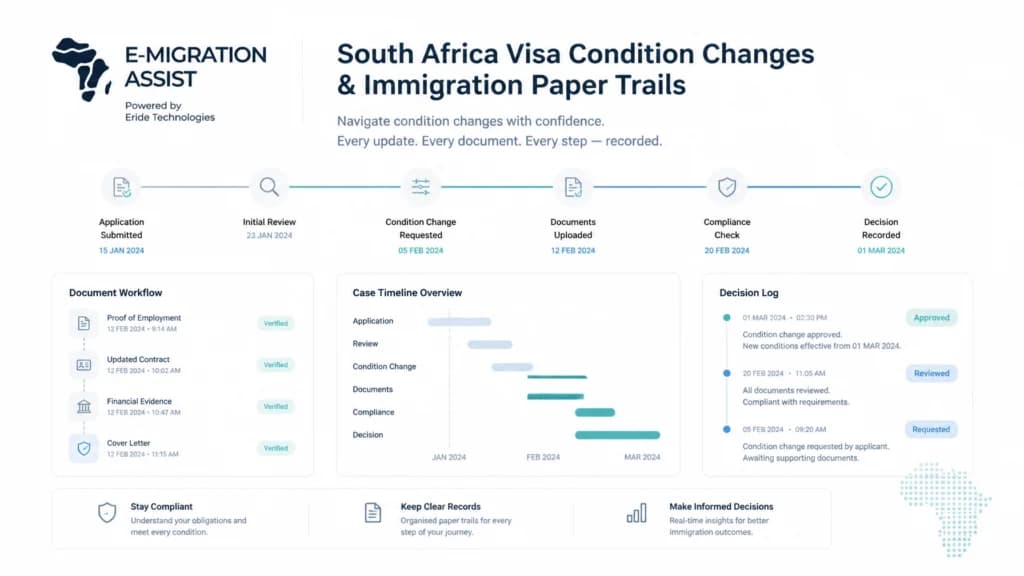
Hook caption: A new job, a new address or a changed travel plan can affect more than your calendar. Before you act, check what your visa actually permits: and build the paper trail that proves what changed, when it changed and what you did next.
A visa is not a general permission to do anything in South Africa.
It is permission connected to a purpose, a category and specific conditions. Those conditions may relate to your employment, your studies, your family circumstances, your address or your ability to travel.
That is why a change in your life should trigger a review of your immigration records.
Not panic.
Not assumptions.
A review.
The old way: act first, check later
Life changes quickly.
You accept a new role. Your employer restructures your department. You move to another city. Your university changes your programme. Your relationship status changes. You decide to travel while an application or appeal is pending.
The paperwork often comes later.
That creates risk.
- : You rely on an old visa without checking its conditions.
- : You assume a new employer or course is automatically covered.
- : You mention a change in an email but do not retain the supporting evidence.
- : You cannot remember when the change happened.
- : You lose track of who was responsible for reviewing the situation.
- : You travel without confirming the documents needed for departure or re-entry.
The result is an overwhelming and disorganised record. Important facts are spread across email threads, WhatsApp messages, cloud folders and paper files.
That is not a reliable compliance system.
The new way: treat every change as a case event
A change in circumstances does not automatically tell you what to do next.
It tells you to stop and examine the connection between:
- Your current visa.
- The activity or circumstances supporting it.
- The conditions printed on the visa or recorded in the decision.
- The evidence available today.
- The advice provided by a qualified immigration professional or attorney.
The South African Government’s visa guidance explains that visas relate to the purpose of a visit and that travellers must hold the appropriate permission before entering South Africa. The practical point is simple: your intended activity and your immigration permission should remain aligned.
If they no longer appear aligned, do not guess.
Create a record. Gather the facts. Obtain advice. Record the next review.
That creates clarity before action.

Five changes that should trigger a visa conditions review
1. Your employment changes
A change may involve more than accepting a completely different job.
It could include:
- A new employer.
- A new job title.
- A new work location.
- A change in duties.
- A material change to the employment arrangement.
- A restructure, merger or transfer within a corporate group.
- A contract ending earlier than expected.
Do not assume that a visa connected to one employment arrangement automatically covers another.
The correct next step depends on the visa category, the wording of the conditions, the nature of the change and the applicable process. A professional should assess the facts before the new arrangement begins.
For employers and mobility teams, this is where a centralised case record becomes valuable. The employee file can contain the current visa, employment documents, expiry dates, previous advice, pending applications and review tasks in one controlled location.
- One record for the employee.
- One timeline for the change.
- One responsible person for the next action.
The result is less admin and more control.
2. Your study plans change
Students may change institutions, programmes, campuses or study intensity.
They may take a leave of absence. They may finish early. They may receive a new offer. They may decide to work, remain in South Africa or change their longer-term plans.
Each situation requires careful checking.
A study visa is connected to the study purpose and the information supporting the application. If the underlying facts change, review whether the current permission still reflects the planned activity.
Keep the evidence together:
- The original admission or enrolment documentation.
- Current registration records.
- Correspondence from the institution.
- Notices about programme or institution changes.
- Dates of withdrawal, completion or interruption.
- Any advice received about the next immigration step.
Do not rely on a verbal conversation or an incomplete email trail. A structured record helps the student, institution and immigration professional understand the sequence of events.
- Trigger recorded.
- Date confirmed.
- Evidence stored securely.
- Advice linked to the event.
That is a more confident way to manage a confusing change.
3. Your address or contact details change
An address change may seem administrative.
It can still matter.
If correspondence, appointment information or a decision is sent to an old address or outdated contact detail, you may miss an important deadline. The risk increases when you have a pending application, appeal or other immigration matter.
Record:
- The previous address.
- The new address.
- The date you moved.
- Proof connected to the new address.
- The systems or parties that may need to be updated.
- Confirmation that the update was completed, where applicable.
The exact notification process can depend on the matter and the relevant authority or service provider. Confirm the required process rather than relying on a general assumption.
A case management platform can also create a review task when contact information changes. That turns a forgotten admin item into a visible workflow step.
- Accurate records.
- Fewer missed communications.
- Clear ownership.
- Better auditability.
The outcome is simple: less searching and more control.
4. Your family circumstances change
Marriage, divorce, separation, the birth of a child, the death of a sponsor or a change in dependency can affect the facts supporting an immigration application or visa.
That does not mean a particular outcome is automatic.
It means the underlying basis should be reviewed.
Store the relevant documents with the date and context. Avoid uploading sensitive records into uncontrolled chat groups or sending them through multiple personal email accounts. Use a secure document process with clear permissions and a record of who reviewed what.
For professional firms, a family-status event should be visible without exposing unnecessary personal information to every person working on the file. A privacy-first workflow supports both operational control and responsible handling of personal data.
E-Migration Assist is designed to support secure document handling and structured case management. It does not replace legal or immigration advice. A qualified professional should assess how the change affects the individual case.
5. Your travel plans change
Travel is often treated as a separate issue.
It should not be.
A change in travel dates, an unexpected departure, a planned return or a trip taken while an application is pending can create new questions:
- Is the current visa still valid on the travel date?
- What documents should be carried?
- Is re-entry subject to a separate requirement?
- Is there a pending application, appeal or concession to verify?
- Could travel affect an appointment, submission or response deadline?
- Has the advice been reviewed against the latest available guidance?
The South African Government states that visas are not issued at ports of entry and that airlines may require evidence of a valid visa before boarding. For matters involving delayed applications or appeals, review current guidance and obtain professional advice. For example, KPMG’s 2026 global mobility alert describes temporary concessions and their conditions, including limits connected to the holder’s existing visa conditions.
Do not treat a concession, receipt or pending application as a universal permission to change activities.
Record the travel plan. Record the documents checked. Record the advice received. Record the next review date.
That is how travel becomes a managed event instead of a last-minute risk.
A practical decision-log framework
Use this six-part structure whenever something changes.
1. Trigger
What happened?
Write a precise description. For example: “Employer notified applicant of a proposed role change,” rather than “work changed.”
2. Date
When did it happen?
Record the date of the event, the date it was discovered and any future date when the change may take effect.
3. Evidence
What proves the change?
Attach the relevant letter, contract, enrolment record, address document, family document, travel itinerary or official correspondence.
4. Responsible person
Who owns the next step?
This may be the applicant, HR or global mobility, a case manager, an immigration practitioner or an attorney. One task should have one clear owner.
5. Advice
What guidance was obtained?
Record who provided it, when it was provided, what documents were considered and what questions remain unresolved. Do not treat an internal note as legal or immigration advice unless it was provided by an appropriately qualified adviser.
6. Next review
When will the case be checked again?
Set a date before the change takes effect, before travel, before an expiry date or after a relevant decision. A review date prevents the file from becoming inactive after the first conversation.

From paper trail to visa tracking in South Africa
A paper trail is only useful if you can find it.
The old way is a spreadsheet with outdated status labels, documents in separate folders and reminders buried in email.
The structured way connects:
- The visa category.
- The current conditions.
- The change event.
- The evidence.
- The person responsible.
- The advice record.
- The next review date.
- The final outcome.
E-Migration Assist provides infrastructure for individuals and professional firms managing South African immigration cases. Its workflows, secure document handling, requirements checklists, tracking and decision logging help create a single source of truth.
For individuals, that means a clearer process and fewer forgotten steps.
For immigration practitioners, law firms and corporate mobility teams, it means a repeatable system that supports more cases without relying on scattered spreadsheets.
You can explore visa tracking South Africa support for travellers, or review the professional case management workflow.
The bottom line
When your circumstances change, the first question should not be, “Can I just continue?”
The first question should be, “What changed, when did it change and what does my current permission say?”
Then:
- Capture the trigger.
- Confirm the date.
- Secure the evidence.
- Assign responsibility.
- Obtain qualified advice.
- Schedule the next review.
Do not act on assumptions. Do not let a significant change disappear inside an inbox.
Start with the paper trail. Build the system around it. That is how you move from an overwhelming immigration process to less admin, more clarity and more control.
Ready to structure your immigration workflow?
Whether you are planning a move to South Africa or managing multiple applications for clients and employees, E-Migration Assist gives you a powered foundation for organised case management.
Start your assessment and create a clearer, more structured path forward.
SEO keywords: South Africa visa conditions, change in circumstances visa South Africa, South Africa work visa change employer, South Africa study visa change institution, South Africa visa tracking, immigration case management South Africa, visa compliance South Africa, South Africa immigration application tracking, visa document management, global mobility case management
Hashtags: #SouthAfricaVisa #VisaCompliance #ImmigrationSouthAfrica #VisaTracking #ImmigrationCaseManagement #GlobalMobility #LegalTech #ImmigrationTech #WorkVisa #StudyVisa #EMigrationAssist