


 Check Your Eligibility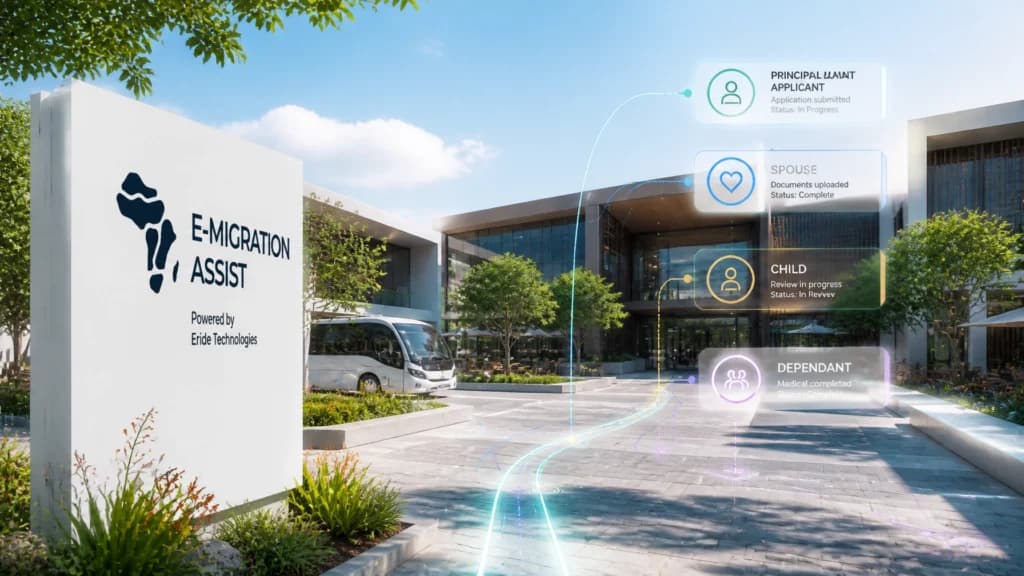
Hook caption:
One family. Multiple applicants. Shared evidence. Different deadlines.
If the case lives across emails, spreadsheets and separate folders, something important can be missed. Here is how to create family-level visibility when moving to South Africa.
Moving to South Africa as a family can feel like one decision.
The case, however, is rarely one application.
There may be a principal applicant. A spouse. Children. Other dependants. Each person may have a different form, document set, appointment, status and expiry date.
The family may be travelling together. The case still needs structure.
This is especially important when exploring a South Africa spousal visa, a South Africa relative visa, or accompanying applications connected to a principal temporary residence visa.
This article is about coordination. It is not eligibility advice or a substitute for legal interpretation. Visa categories, requirements and conditions can depend on the family’s circumstances. For legal guidance, consult a qualified immigration professional.
The family move problem: one plan, several case files
Families often begin with a shared question:
“What do we need to move to South Africa?”
The answer may not fit into one checklist.
A family application can involve:
- : one principal applicant with a work, business, study or other visa pathway
- : a spouse applying through a family-related route
- : children requiring proof of birth, custody or parental consent
- : dependants with separate supporting evidence
- : documents issued in different countries
- : applications submitted at different times
- : decisions received on different dates
- : visas with different validity periods or conditions
The old way is familiar.
A spreadsheet tracks the principal applicant. Email threads contain the spouse’s documents. A messaging app holds a photograph of a birth certificate. A school or employer asks for proof of status. Nobody is certain which file is the latest version.
That is not a family-level case system.
The new way starts by treating the family as a connected case group while keeping every applicant’s application distinct.
- One family profile
- Linked applicant records
- Shared evidence library
- Individual requirement checklists
- Central status and expiry visibility
The result is simple: less admin and more control.
A linked case is not the same as one application
This distinction matters.
A family can be managed as one connected case group without treating every person as having identical requirements.
The principal applicant’s case may be the anchor. The spouse’s case may depend on proof of the relationship. A child’s case may depend on a birth certificate, custody document or consent from a non-accompanying parent. Another dependant may require separate proof of kinship or financial support.
The applications are connected.
They are not interchangeable.
This means a family workflow should show two views at the same time:
The individual view
Each applicant needs:
- : their own identity details
- : their own passport and validity information
- : their own forms
- : their own supporting documents
- : their own submission status
- : their own decision record
- : their own visa conditions and expiry date
The family view
The household needs:
- +a clear list of all linked applicants
- +the relationship between each person and the principal applicant or sponsor
- +shared documents visible to the authorised case team
- +dependencies between applications
- +a combined view of outstanding actions
- +a timeline showing the whole family’s progress
This structure prevents two common errors.
First, a document may be uploaded repeatedly because nobody knows it already exists.
Second, an individual task may be overlooked because the family is being treated as one general application.
A connected system protects both accuracy and independence.
Shared evidence should be reusable, not duplicated
Family applications often rely on evidence that supports more than one person.
Examples may include:
- a marriage certificate
- birth certificates
- proof of custody
- parental consent
- proof of accommodation
- sponsor identity documents
- financial records
- police clearances
- medical documentation
- proof of relationship
- certified translations
- supporting letters
The problem is not only collecting the documents.
The problem is knowing:
- Which document supports which applicant?
- Whether the document has been certified correctly.
- Whether the document needs translation.
- Whether the document has already been reviewed.
- Whether the document is still valid or usable.
- Whether a new version has replaced an older version.
A shared evidence library creates a single controlled source.
The document can be uploaded once. It can then be mapped to the relevant applicant records and checklist items.
That does not remove the need for human review. It makes the review more consistent.
For example, a marriage certificate may support the spouse’s relationship evidence. A birth certificate may support a child’s relationship evidence. A sponsor’s identity document may support several linked applications.
The system should make these connections visible.
: No searching through six email chains.
: No guessing which attachment is final.
: No asking the family to resend the same document.
+Upload once.
+Map clearly.
+Review centrally.
+Reuse securely.
This is the difference between storing documents and managing evidence.

Different expiry dates create a family risk
A family may enter South Africa together. Their immigration records may not expire together.
Validity can be affected by:
- the visa category
- the date of issue
- the date of entry
- the principal applicant’s visa validity
- the date a dependant’s application is approved
- passport validity
- the conditions attached to each visa
- subsequent extensions or changes
The official South African High Commission guidance on Relative’s Visas notes that the validity period may be linked to the financial assurance provided and may not exceed the prescribed maximum period. It also lists documentation that can arise in family cases, including marriage certificates, custody evidence, adoption documents and parental consent.
These details show why a single family travel date is not enough.
A family-level dashboard should show:
- the expiry date for every applicant
- the next review date
- the date supporting documents were uploaded
- the date a document was reviewed
- actions required from the family
- actions assigned to the professional representative
- the relationship between a dependant’s status and the principal case
Without this view, a family may assume:
“Our visas expire at the same time.”
That assumption can create avoidable pressure.
A better system turns dates into controlled actions:
- Record each validity period.
- Flag approaching deadlines.
- Separate completed tasks from pending tasks.
- Keep a decision log for every applicant.
- Show the family’s overall position without hiding individual risks.
The outcome is not merely a calendar reminder. It is operational control.
South Africa visa requirements need a family checklist
Searching for South Africa visa requirements usually produces a long list of possible documents.
The list can become confusing when several family members are involved.
A family should not rely on one generic checklist. It needs a structured checklist that distinguishes between:
Documents for the principal applicant
These may relate to the principal visa category, intended activity, qualifications, employment, study or financial position. The exact requirements depend on the applicable route.
Documents for the spouse
A spouse may need evidence relevant to the relationship and the selected visa category. A South Africa spousal visa can involve different conditions and supporting evidence from a Relative’s Visa.
Documents for children
Children’s records may require birth certificates, adoption documents, custody evidence or parental consent, depending on the circumstances.
Documents for other relatives or dependants
A South Africa relative visa application may require evidence of kinship, dependency, sponsorship or financial assurance. The appropriate evidence depends on the applicant’s situation and the legal route being considered.
The key point is not to predict a universal document list.
The key point is to organise the correct list after the visa route has been assessed by a qualified professional.
E-Migration Assist supports this process through structured workflows, guided document handling and human-reviewed case progression. It does not replace legal advice. It gives individuals and the firms assisting them a controlled place to manage the work.
The professional’s view: one family relationship, many actions
For immigration practitioners, attorneys and global mobility teams, family cases create a different type of workload.
The relationship between applicants is obvious to the family. It may not be obvious in a practice’s internal systems.
A professional may need to:
- open several applications
- request similar documents from the same client
- apply different checklists
- track different submission dates
- monitor separate correspondence
- explain progress to the family
- identify missing evidence
- record decisions and follow-up actions
- manage future renewals or changes
Spreadsheets can list names.
They do not always show dependencies.
Email can send documents.
It does not create reliable case visibility.
A case-management infrastructure can connect each applicant to the family group while preserving individual records. It can also create repeatable workflows for firms assisting multiple families.
That means:
- fewer duplicated requests
- fewer manual status checks
- fewer disconnected files
- more consistent review
- clearer client communication
- better operational scale
The technology becomes a powered foundation for accuracy, privacy and compliance.
The family’s view: confidence comes from knowing what happens next
Families do not need another notice board.
They need answers to practical questions:
- What has been received?
- What is still missing?
- Who needs to act?
- Which document supports which person?
- Has the principal application moved forward?
- Are the children’s applications linked correctly?
- Which expiry date comes first?
- What should be reviewed next?
A clear system reduces the emotional cost of uncertainty.
It gives the family a shared picture without exposing sensitive information unnecessarily. It gives the assisting professional a controlled workflow. It creates a record that can be reviewed instead of reconstructed.
That is especially valuable when family members are in different countries or when applications are submitted through different channels.
Visibility is not a luxury.
It is part of responsible case administration.

Build the family case before the paperwork becomes overwhelming
A structured family case should answer three questions from the beginning:
Who is connected?
Create the family group. Identify the principal applicant, spouse, children and other dependants. Record the relationship between each applicant.
What is shared?
Create a controlled evidence library. Map shared documents to the relevant applicants. Record review status and version history.
What is different?
Apply individual workflows. Track separate requirements, submissions, decisions, conditions and expiry dates.
This approach does not make legal interpretation automatic.
It makes the administrative system dependable.
For individuals, that means a clearer route from assessment to submission.
For immigration professionals and law firms, it means a repeatable structure for managing complex family groups.
For corporate mobility teams, it means better visibility over relocation dependencies and employee family support.
The family move may be personal. The case management should be precise.
From separate files to one controlled family view
A family does not need to choose between individual applications and a shared plan.
It needs both.
: The old way: disconnected files, repeated requests, unclear deadlines.
+The new way: linked cases, shared evidence, individual checklists and family-level visibility.
E-Migration Assist provides supportive infrastructure for South African immigration case management. Individuals can use structured guidance and secure document handling. Professional firms can manage connected applicants, workflows, status updates and decision records in one place.
If your family is preparing to move to South Africa, start with a structured assessment at https://emigration-assist.com/assessment.
If you assist families professionally, explore how to run immigration cases with structure instead of spreadsheets or book a firm demo.
Legal interpretation belongs with a qualified immigration professional.
Case visibility belongs in a system.
One family. Multiple applications. Shared evidence. More control.
#SouthAfricaVisa #SouthAfricaSpousalVisa #SouthAfricaRelativeVisa #SouthAfricaVisaRequirements #ImmigrationToSouthAfrica #FamilyMigration #GlobalMobility #ImmigrationProfessionals #VisaApplication #ImmigrationCaseManagement #LegalTech #E_MigrationAssist
