


 Check Your Eligibility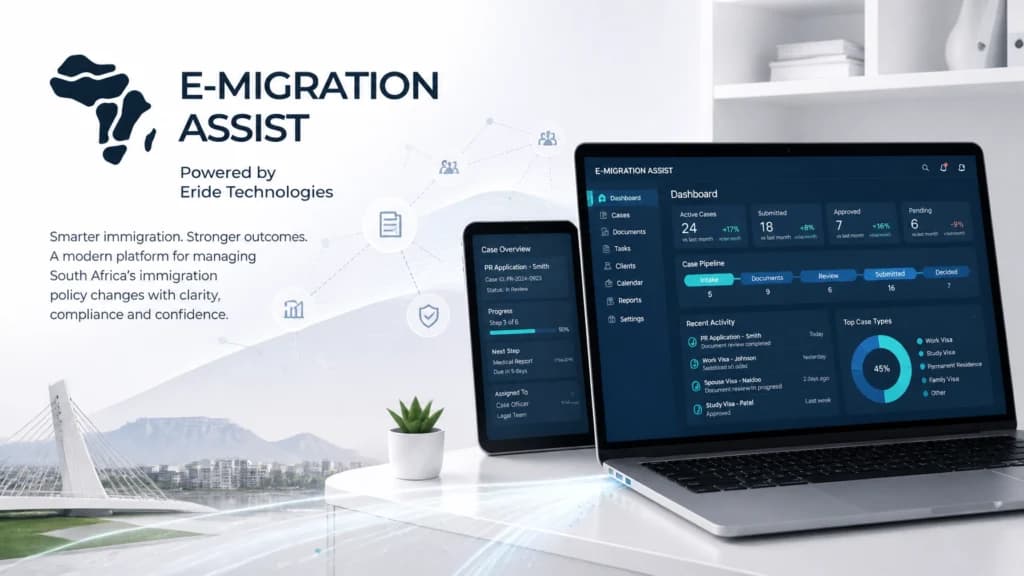
Hook caption:
A policy update is not just something to read. It is something to trace, apply, communicate and record. Here is how professional firms and employers can stay ready when South Africa’s immigration reform moves faster than their spreadsheet.
South African immigration reform in 2026 is creating a familiar problem for immigration practitioners, law firms and employers:
The direction is changing. The detail is still developing. Cases are already moving.
That creates pressure.
: A new policy document appears.
: A team member reads a summary.
: Someone updates a spreadsheet.
: A client receives an email.
: Nobody is completely sure which cases are affected.
This is how confusion begins.
The solution is not to react faster with more emails. The solution is to create a controlled policy change management system.
That means checking the source, confirming the legal status, recording effective dates, identifying affected cases, updating checklists and retaining an audit trail.
The result is less admin and more control.
Policy direction is not the same as a legal requirement
In April 2026, Cabinet approved the Revised White Paper on Citizenship, Immigration and Refugee Protection. The official government statement describes the White Paper as a major policy direction for reforming South Africa’s citizenship, immigration and refugee protection frameworks.
It also states that the Department of Home Affairs will begin drafting the legislative amendments required to implement the policy.
That distinction matters.
A White Paper can signal the direction of future reform. It does not automatically replace the current law. Proposed visa categories, points-based systems, annual application windows or new compliance requirements should not be treated as enforceable rules until the appropriate legislation or regulations are finalised and brought into effect.
This is where many manual processes fail.
: A proposal is copied into a checklist as if it were law.
: A social media summary replaces the primary source.
: A policy announcement is applied to every case, regardless of stage.
: Old versions remain in circulation.
A controlled workflow creates a different outcome:
- The source is recorded.
- The status is classified as current law, guidance, proposal or pending change.
- The effective date is captured.
- The affected case types are identified.
- The team knows what action is required.
This is the foundation of reliable immigration case management.

Step one: check the source before changing the process
Not every policy update deserves the same response.
A forwarded message from a colleague may be useful as an alert. It is not necessarily a reliable operational source. A blog post may explain a development clearly. It is not a substitute for the underlying legal instrument.
A professional change management workflow should begin with source checking.
Start with the following questions:
- Who issued the update?
- What exactly has been published?
- Is it legislation, a regulation, a directive, a notice, a court decision, a policy document or a public statement?
- Has it been gazetted?
- Does it include a commencement or effective date?
- Which visa types, applicants or employers does it affect?
- Does it change the legal position or only provide policy direction?
The KPMG analysis of the 2026 Revised White Paper highlights several proposed changes, including new visa categories, a points-based approach and expanded digitalisation.
Those developments are important for workforce planning. They are also a reminder to separate preparation from implementation.
A team can prepare for a proposed Skilled Worker Visa without telling a client that the visa is already available. It can review skills records without replacing the current application requirements. It can map potential impacts without creating false certainty.
That is what controlled infrastructure enables.
Step two: attach an effective date to every change
A policy update without a date is incomplete.
The date may be:
- The date the law commenced.
- The date a regulation takes effect.
- The date a temporary concession expires.
- The date a directive was issued.
- The date a new application process opens.
- The date a previous requirement stops applying.
Without this information, teams cannot reliably decide which version belongs to which case.
Consider three applicants:
- Applicant A submitted before the change.
- Applicant B is preparing an application but has not submitted.
- Applicant C is renewing after the change takes effect.
The same update may affect each applicant differently.
A spreadsheet may contain the visa type. It may contain the submission date. It may contain a notes column. But a notes column is not a policy control system.
An effective case management workflow should connect:
- Policy version.
- Case stage.
- Submission date.
- Expiry date.
- Required documents.
- Responsible reviewer.
- Communication status.
This creates a clear answer to a critical question:
Which rule set was used, and why?
That answer matters for quality control, client communication and future review.
Step three: identify the cases that are actually affected
The next challenge is scope.
A policy change may affect a specific visa category, a specific type of employer, a specific stage of an application or only future submissions. Applying it too broadly can create unnecessary work. Applying it too narrowly can create compliance risk.
The old way is manual:
: Search a spreadsheet by visa name.
: Open individual folders.
: Review emails for context.
: Ask colleagues who is handling what.
: Build a temporary list.
The new way is structured:
- Tag cases by visa category.
- Tag cases by application stage.
- Tag cases by employer or programme.
- Tag cases by expiry and renewal date.
- Flag cases requiring human review.
- Assign a documented action.
For employers and corporate mobility teams, this can include identifying employees whose assignment plans may depend on future visa categories or revised eligibility criteria.
For professional firms, it can include separating:
- Active applications.
- Pending submissions.
- Renewals.
- Status changes.
- Dependant applications.
- Permanent residence planning.
- Cases awaiting client documents.
- Cases requiring legal interpretation.
The goal is not to automate legal judgement. The goal is to ensure that legal judgement is applied to the right case, at the right time, with the right information.
That means less admin and more control.

Step four: version the checklist instead of overwriting it
One of the most common spreadsheet mistakes is overwriting the old checklist.
The latest requirement is added. The previous requirement disappears. Months later, a reviewer cannot tell what changed, when it changed or which cases were processed under the earlier version.
A versioned checklist solves this.
Each checklist should have:
- A clear visa or case type.
- A version number.
- A publication or review date.
- A source reference.
- An effective date.
- A list of changes.
- Approval or review ownership.
- A record of which cases used it.
For example:
Temporary Residence Checklist : Version 3.2
- Reviewed: 19 September 2026.
- Source: current official requirements and applicable guidance.
- Status: active for new cases from the review date.
- Change: document instruction clarified.
- Previous version: retained for historical case records.
- Reviewer: assigned professional or internal compliance owner.
This structure makes change visible.
It also protects the integrity of the case file. If a requirement changes later, the firm can demonstrate that the application was prepared against the information available and applicable at the time.
That is the difference between an editable document and an auditable system.
Step five: communicate the change without creating panic
Policy communication should be conversational, specific and proportionate.
Clients and employees do not need a wall of legal terminology. They need to know:
- What has changed.
- What has not changed.
- Whether their case is affected.
- What action is required.
- By when.
- Who is reviewing the position.
A useful message might say:
“South Africa has approved a revised policy direction for citizenship, immigration and refugee protection. The policy includes proposed future changes, but it does not automatically replace the current visa requirements. We are reviewing the development against your case stage and will confirm whether any action is required.”
That message is clear without overpromising.
It also creates room for professional review.
Avoid messages such as:
- “The new visa system is now active.”
- “All applications must follow the new points system.”
- “Your current visa is no longer valid.”
- “You must submit immediately because the rules have changed.”
Unless those statements are supported by an applicable legal instrument and commencement date, they can create unnecessary fear and incorrect action.
Good communication creates confidence. It does not create noise.
Why an audit trail is now essential
Immigration cases involve sensitive documents, changing requirements and decisions made across multiple people.
An audit trail should show:
- The source reviewed.
- The date it was reviewed.
- The interpretation recorded.
- The checklist version selected.
- The cases assessed.
- The communication sent.
- The documents received.
- The decision or action taken.
- The person responsible for each step.
This is especially important as South Africa’s immigration system moves toward greater digitalisation. The policy direction includes digital transformation, improved data management and more integrated immigration processes.
The E-Migration Assist article on the rebuilding of South Africa’s immigration system explores that broader shift.
Digital government processes require digital organisational discipline from the professionals and employers using them.
A secure audit trail supports:
- Consistent review.
- Faster handovers.
- Better client updates.
- Stronger compliance evidence.
- Fewer duplicated tasks.
- More reliable operational reporting.
The result is a professional workflow that can adapt without losing its history.

Build the system before the next change arrives
The next immigration update may concern visa categories, digital applications, employer obligations, permanent residence processes or temporary concessions.
The specific subject will change. The operational requirement will not.
You need a process that can:
- Monitor trusted sources.
- Record policy status.
- Separate proposals from law.
- Assign effective dates.
- Map changes to affected cases.
- Update checklists without deleting history.
- Notify the right stakeholders.
- Preserve a complete audit trail.
That is where immigration case management software becomes more than a digital filing cabinet.
E-Migration Assist provides case management infrastructure for South African immigration. It supports structured workflows, secure document handling, requirements checklists, case tracking and decision logging.
It supports immigration practitioners, law firms, corporate mobility teams and individual travellers. It does not replace legal advice or the professional judgement of a qualified immigration practitioner.
The old way is reactive:
: Spreadsheets.
: Scattered emails.
: Unclear versions.
: Repeated document requests.
: Uncertain case ownership.
The new way is controlled:
- Centralised case information.
- Versioned workflows.
- Secure document handling.
- Human-reviewed guidance.
- Clear status tracking.
- A retained decision history.
When the policy moves faster than the spreadsheet, the answer is not more spreadsheets. It is a powered foundation for accuracy, compliance and control.
Start your assessment with E-Migration Assist and bring structure to your immigration workflow.
#SouthAfricaImmigration #SouthAfricaImmigrationReform2026 #ImmigrationCaseManagementSoftware #GlobalMobility #ImmigrationCompliance #VisaApplications #ImmigrationPractitioners #CorporateMobility #LegalTech #ImmigrationTechnology #CaseManagement #EMigrationAssist
This article is provided for general information and does not constitute legal advice. South African immigration requirements and implementation timelines may change. Proposed reforms should not be treated as law until enacted and brought into effect. Confirm the current position with the relevant authority or a qualified immigration professional.